15 Best Student Resume Examples and Templates

A CV is your first contact with the hiring company. It doesn’t just show your potential employer what you’ve done and achieved, but also what you can do. In this article, you’ll be able to find some tips and 15 best student resume examples to land your first job!

Your resume should catch the eyes of the typical recruiter who is wading through scores of applications. It should set you apart from the competitors so you can score the job you’re applying for.

Writing a CV is no easy task, especially when you’re overwhelmed with conflicting advice on the internet about how you should go about it. 

But don’t worry! We’ve got you covered – let’s get started!

How Do You Write A Resume If You’re A Student?

Creating a great resume might seem like an overwhelming task. But with the help of our top CV writing tips, you will learn what to incorporate in your document to wow your potential employers.

The Do’s of Resume Writing

Keep It Short

The most effective CV is informative and concise. Get straight to the most relevant points, and don’t use more than two pages.

Tailor Your Resume to the Job

Recruiters are experienced and can identify a generic CV immediately. Instead of trying to fill your CV with achievements, skills, and strengths, focus more on the relevant set of skills, experience, and accomplishments that fit perfectly with the role you are interested in. This way, you can expound more on these attributes and demonstrate to the hiring manager why you will be an excellent addition to the company.

Also, hiring managers love resumes with numbers. For example, “I increased Apple Sale by 300%.” So, ensure you use them whenever possible.

Use the Proper Format and Structure

Before writing your student CV, determine the correct structure and format. Ensure your CV is readable and has a professional look. Although you can be creative with color and heading, don’t go overboard. Use simple and clear font to make your CV easy to read.

Optimize for Applicant Tracking Systems

Today most organizations use applicant tracking systems to discard unqualified applicants. The system scans a CV for keywords and phrases and mathematically scores them for relevance. It then sends out the most qualified applications to recruiters.

To ensure you pass the ATS and secure a chance for an interview, keep your CV format simple and include the right keywords.

Edit and Proofread

There’s nothing worse than a CV full of errors, both typos and grammatical. Such a CV will show the hiring manager you’re careless and don’t pay enough attention to the little details.

After writing your CV, edit and proofread it several times before sending it to your potential employer. Use the many online proofreading tools, but don’t over-rely on them too much. Sometimes, even the best spellchecker can miss a potentially embarrassing spelling mistake.

Alternatively, you can enlist the help of a human proofreader who can offer you constructive feedback about your CV’s content and layout.

The Don’ts of CV Writing

Tell A Lie

Even if you can get away with a lie, it doesn’t mean you should lie. Most hiring managers are diligent than ever before and often perform background checks. Even if you don’t get caught immediately, the lie will eventually come back to haunt you. And when this happens, you will lose your employer’s trust and even your job.

Forget a Cover Letter

One of the most common and biggest mistakes job seekers makes repeatedly is forgetting the cover letter. Even if a job doesn’t require a cover, still send one unless specifically asked not to.

A cover letter can prove incredibly valuable in presenting yourself to recruiters as a well-rounded candidate. This extra effort shows employers you’re more serious about the job and means you’re more likely to secure an interview.

Include Anything Confidential

It seems self-explanatory, but let’s just clarify it. When deciding to leave something on your CV, use the New York Times test. In simple terms, if you wouldn’t want it published next to your credentials on the front page of a major newspaper, get rid of it.

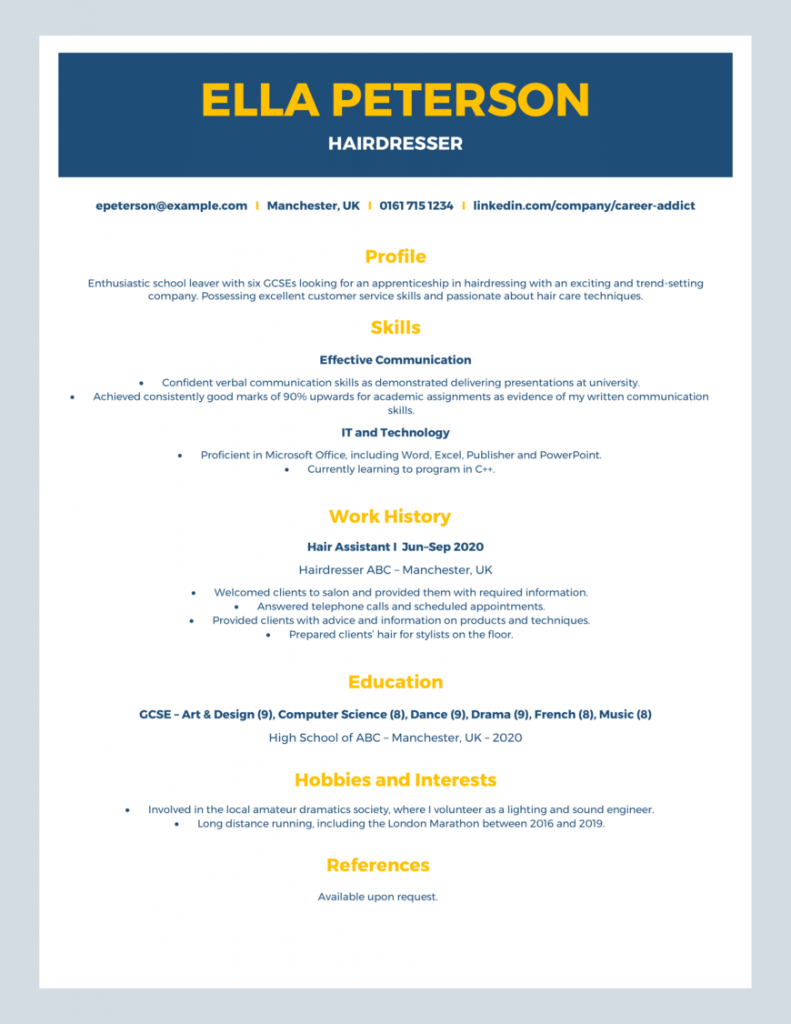
Example of a Good Student Resume:

Here’s a good example to help you get started:
How Can A Student Make A Resume With No Experience?

Is it possible to write a CV when you have no work experience?

Yes! Although It might seem like you have nothing to write about, you shouldn’t let that stop you. Keep in mind sometimes hiring managers are after more than just experience. So, you can use your CV to show them who you are and why you’re the perfect fit for the opportunity.

If you are having difficulty curating a CV because you have no experience, here are five tips to help you out:

Tailor the CV to The Job

When applying for a job with little or no professional experience, try to focus on your skill instead of the experience you don’t have. Employers find your skills more interesting.

It’s wise to have a pre-written list of skills and examples. When writing your CV, you can cross-reference different experiences to create several examples under each heading, with evidence to support your claims. By using examples, you can make your skill CV more powerful, attractive, and believable.

Scan and research your targeted job thoroughly to identify what skills and knowledge you can highlight in your CV.

Leverage Your Transferable Skills

Most hiring managers understand that most students have transferable skills. They don’t always expect them to have skills relevant to the job.

If you have no work experience, you can draw transferable workplace skills from your studies, class projects, and extracurricular activities. This allows you to show that you have valuable skills the employer is searching for.

You can also mention skills you might have learned in another job or industry that are relevant across the board.

Add a Cover Letter

Utilize a cover letter to provide your potential employer with more details about yourself and why you be a valuable addition to their team. Keep your cover letter professional, concise, and lead with a great opener.

Add Some Personality

Always show employers your personality and enthusiasm for the job through the CV, even when you don’t have work experience. Recruiters receive many job applications. Standing out from the competition might help you secure an interview.

Remember, besides work experience, employers are looking for individuals with the right personality to fit with the company culture.

Utilize the Right Keywords

As we mentioned earlier, most recruiters use Applicant Tracking Systems (ATS) to find qualified applicants. The system looks for a specific set of keywords in the CV. Therefore, it’s important to mention skills and qualifications that contain keywords relevant to the job so you can pass the ATS.

If you’re looking for CV templates with no experience to design your CV, look at the example below.

15 Best Student Resume Examples to Land Your First Job

Here, you will find 15 student CV examples to help you design and focus your resume on a specific job. If you have already created your CV, use our CV templates for students to get new ideas and customize your document.

Simple Student Resume
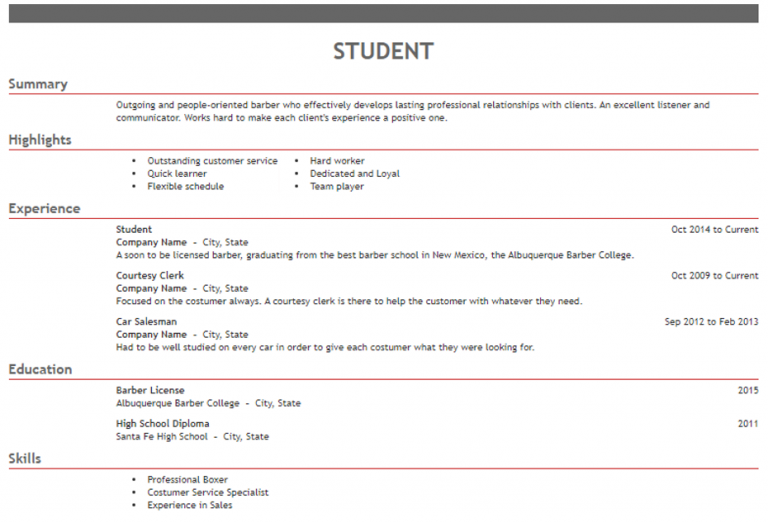
From this example, you can see the student has used a simple and clear structure. The coloring and font are perfect, meaning the recruiter can read the document with ease. The student uses the personal statement section to sell himself to the employer in a short but attractive way. He also highlights the skills that match the job his applying for.

College Student CV
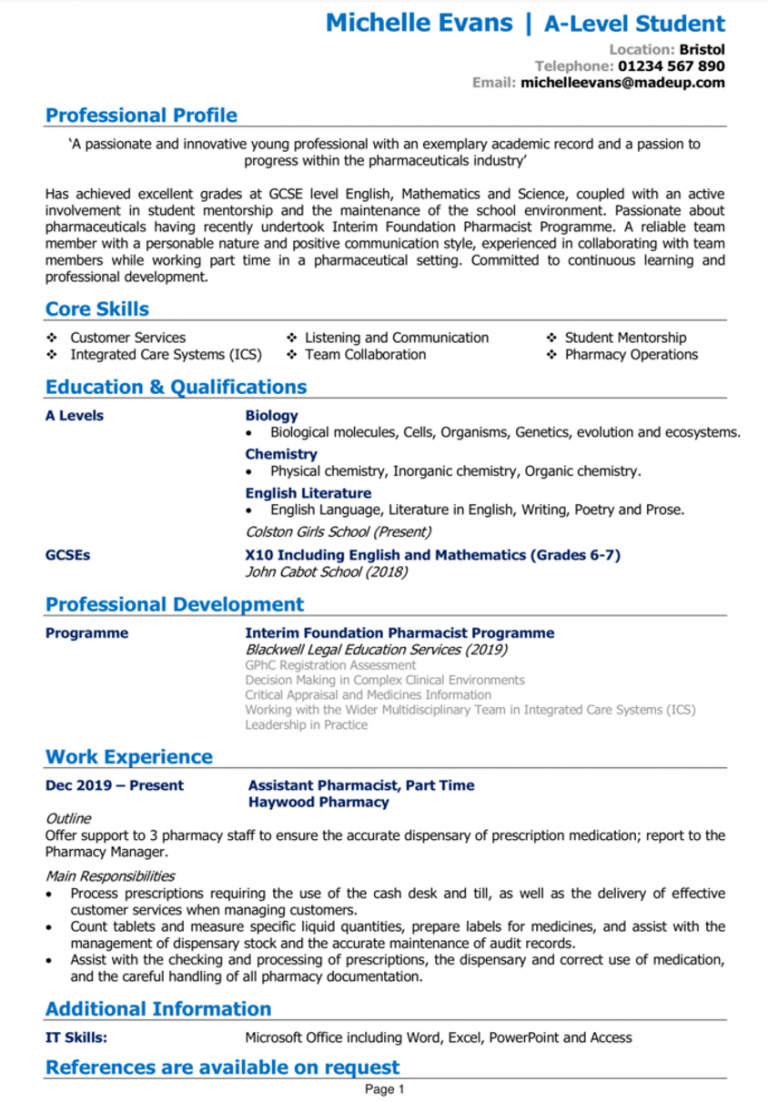
Source: https://standout-cv.com/

In this example, Michelle Evans uses her personal profile to introduce herself. She also describes herself and her ambition. In the work experience section, Evans describes the job she had already done. She mentions the primary responsibilities she undertook and some of the transferrable skills she gained. 

University Student CV
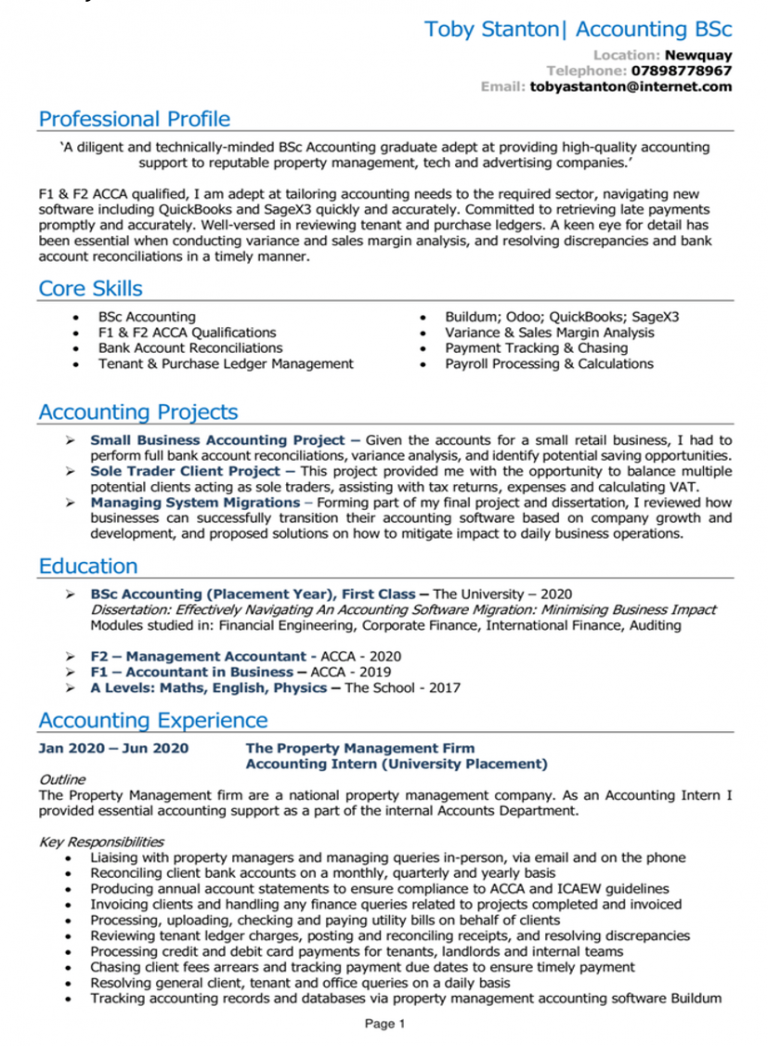
Source: https://standout-cv.com/

Internship CV

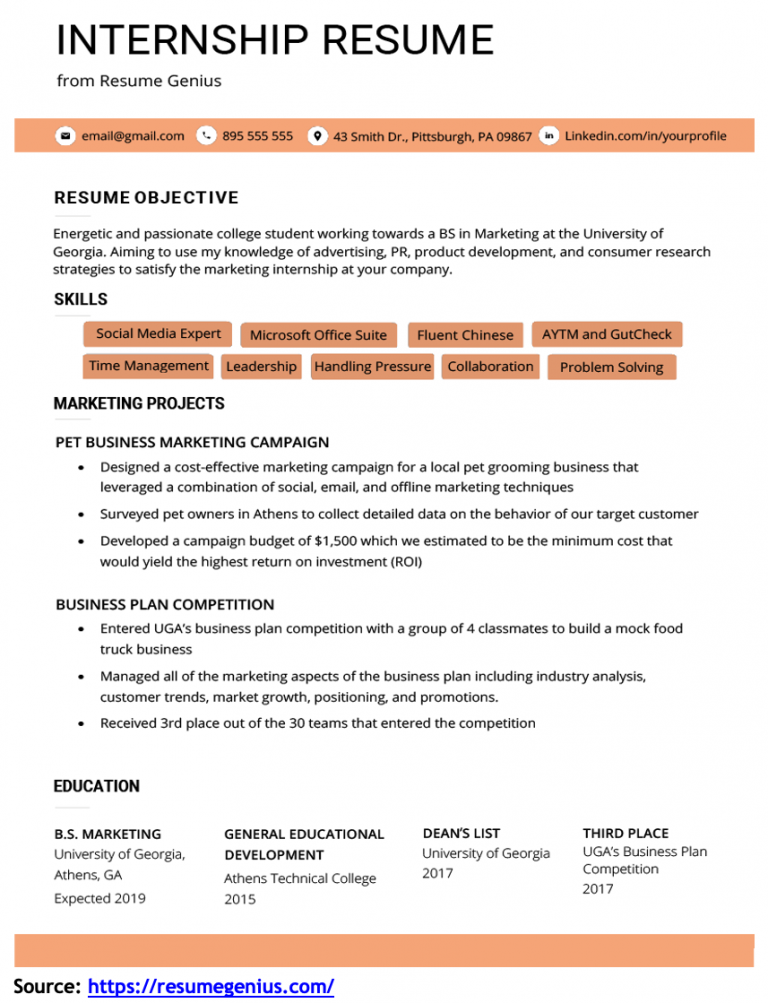
Source: https://resumegenius.com/

Doing an internship is incredibly beneficial to a student’s career development. But often, these positions are very competitive. So a student might need to create a resume that stands out. Resume Templates for students might help you get an idea of how to structure your CV professionally.

In the example, you can see the student has expressed his desire to intern for the company. The student mentions what he will deliver if he secures the internships. When writing an internship CV or resume, it’s wise to sell yourself. You can also throw in some extracurricular activities, though drinking high amounts of alcohol doesn’t count.

M.A. Student Resume Example
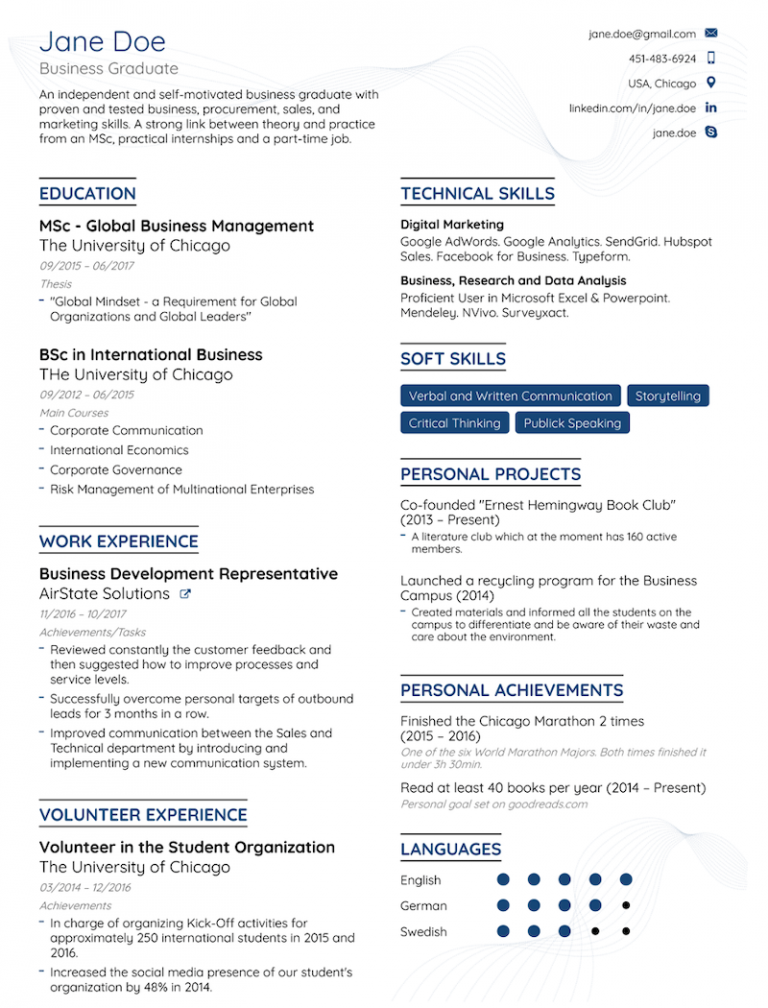
Source: https://novoresume.com/

Doing an internship is incredibly beneficial to a student’s career development. But often, these positions are very competitive. So a student might need to create a resume that stands out. Resume Templates for students might help you get an idea of how to structure your CV professionally.

In the example, you can see the student has expressed his desire to intern for the company. The student mentions what he will deliver if he secures the internships. When writing an internship CV or resume, it’s wise to sell yourself. You can also throw in some extracurricular activities, though drinking high amounts of alcohol doesn’t count.

Medical Student CV Example
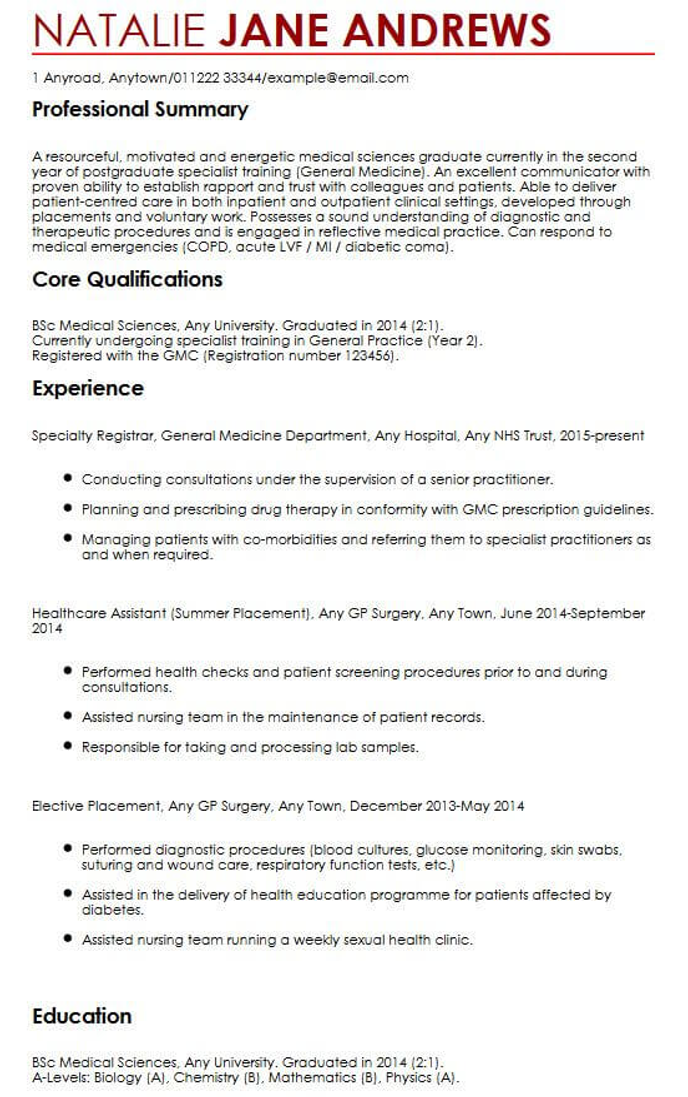
Source: https://www.myperfectcv.co.uk/

Student Support Officer CV Example

Source: https://www.myperfectcv.co.uk/

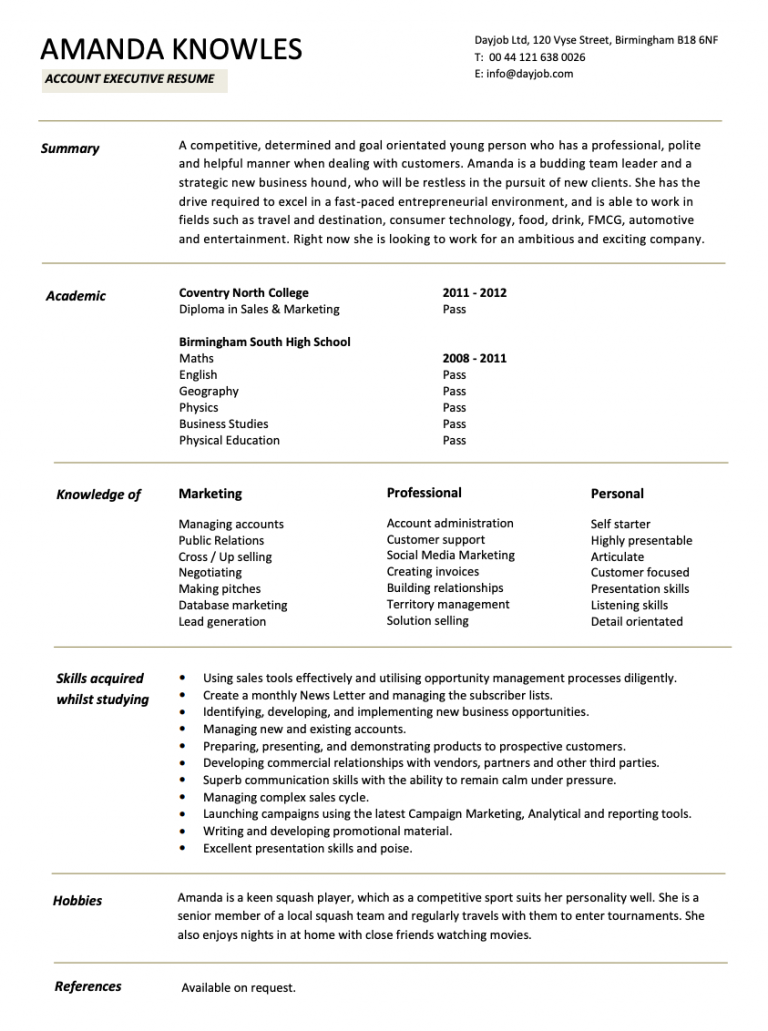
Account Executive Student Resume Example
Source: https://www.dayjob.com/downloads/CV_examples/account_executive_resume.pdf

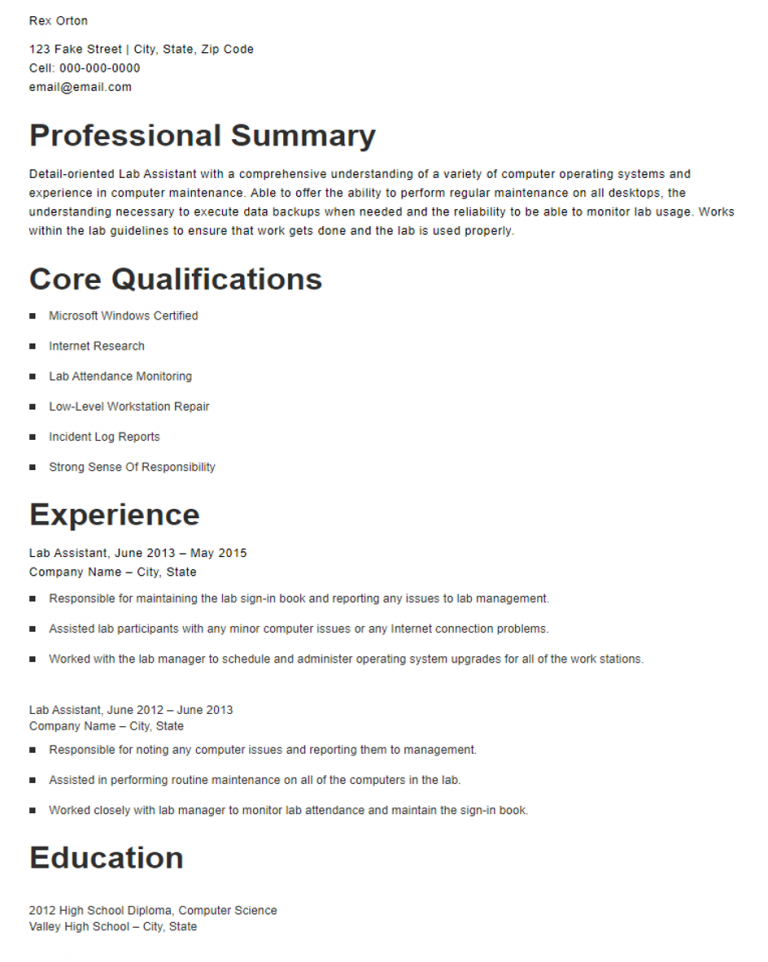
Lab Assistant Student Resume Example

Source: https://www.resume-now.com/

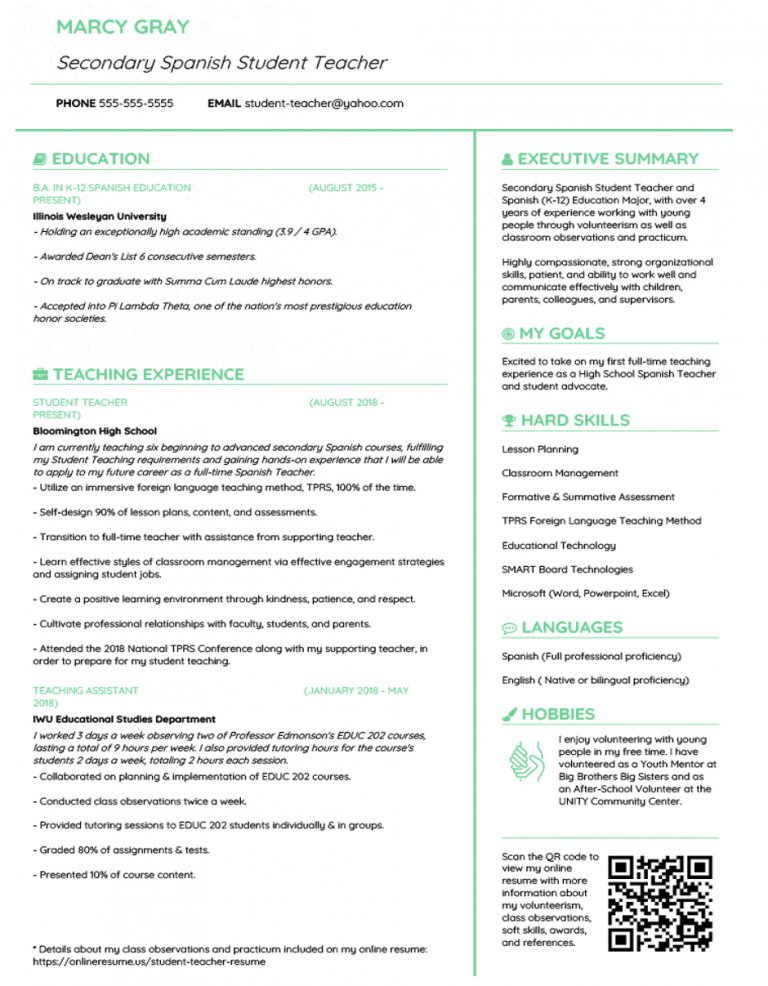
Secondary Teacher Student CV

Source: https://cvonline.me/

A good teacher-student CV should include all the education, certification, and relevant experience. Also, don’t forget teaching and social skills that show you’re a qualified educator.

If you’re currently a student teacher and you possess no certification yet. Clarify that by the time you’re done with your education, you will have your teaching certificate.

Keep in mind that the purpose of your CV is to convince your potential employer that you are the perfect candidate for the job. So list all your relevant experience and skills that make you the ideal candidate for the teaching position. 

If you are having a hard time creating your student teacher CV, check out CV templates for students like the one above to get new ideas on how to write your document.

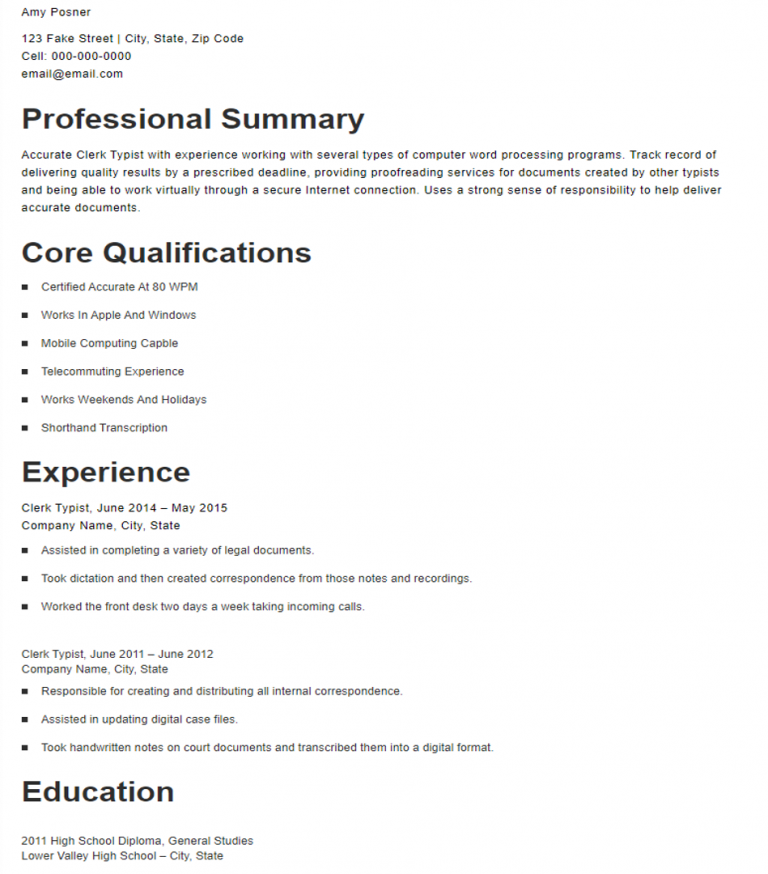
Clerk Typist Student Resume Example
Source: https://www.resume-now.com/

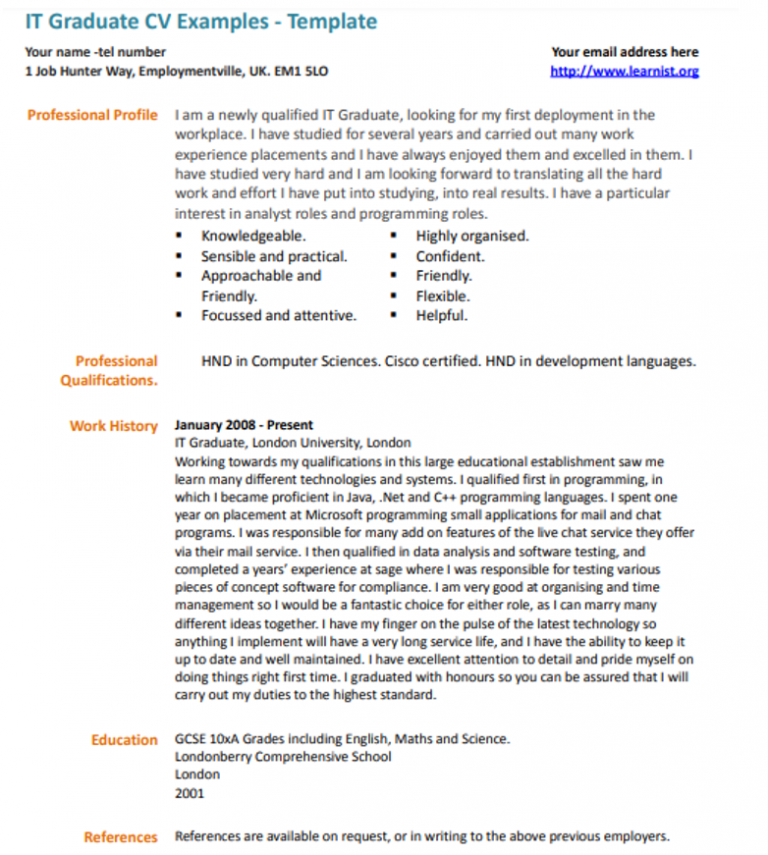
IT Graduate CV Example

Sources: https://www.learnist.org/

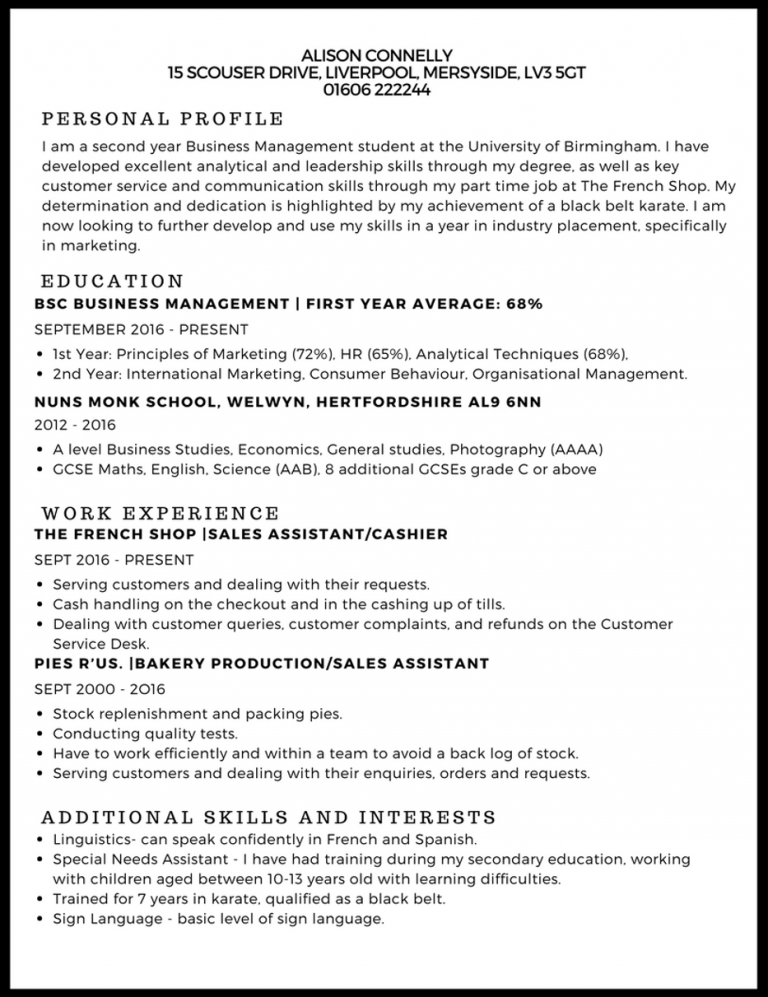
Entry Level Student CV Example

Source: https://www.studentjob.ie/

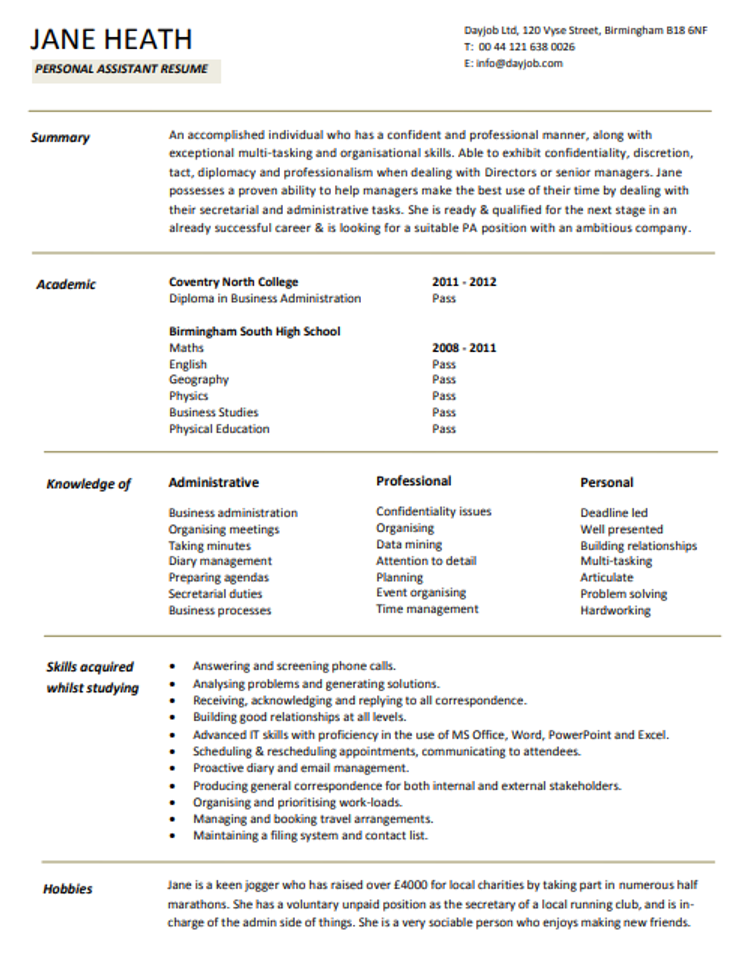
Personal Assistant Student Resume Example
Source: https://www.dayjob.com/

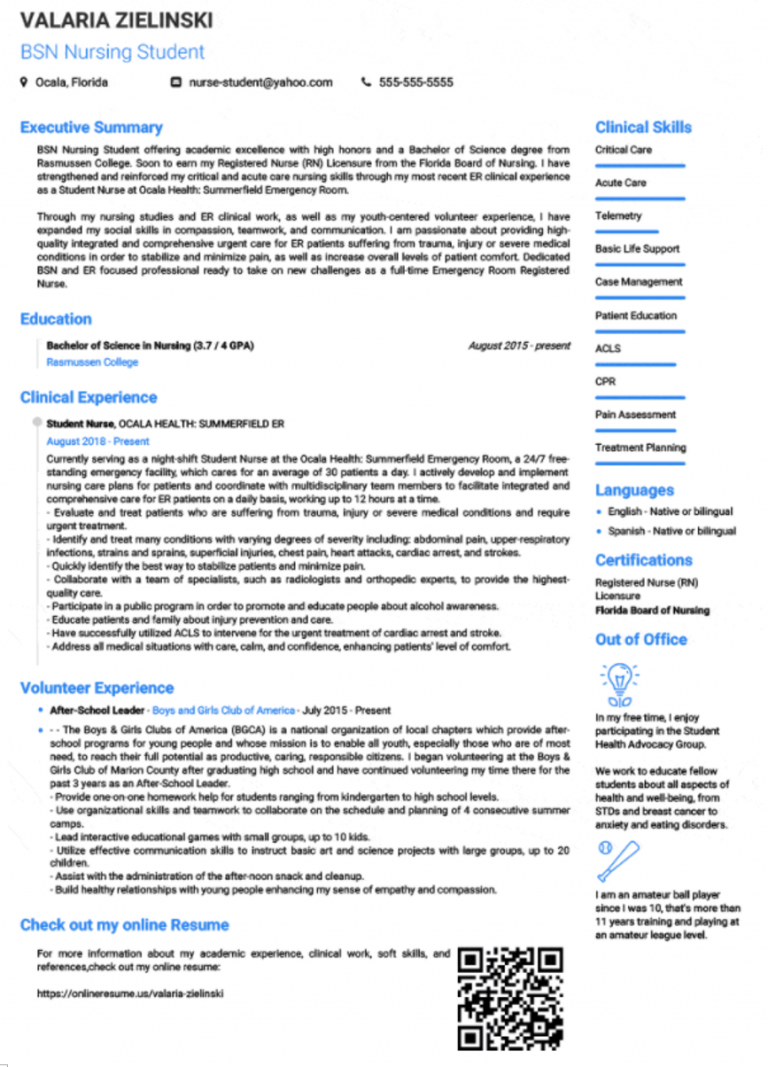
Nursing Student CV Example

Source: https://cvonline.me/

If you’re writing a nursing CV, make sure you include your education, licenses, certification, clinical work experience, and relevant technical skills related to the specific nursing field.

Don’t forget to include the relevant job position you have held before in the medical field. Your work experience section should also include key responsibilities and mention your achievements.

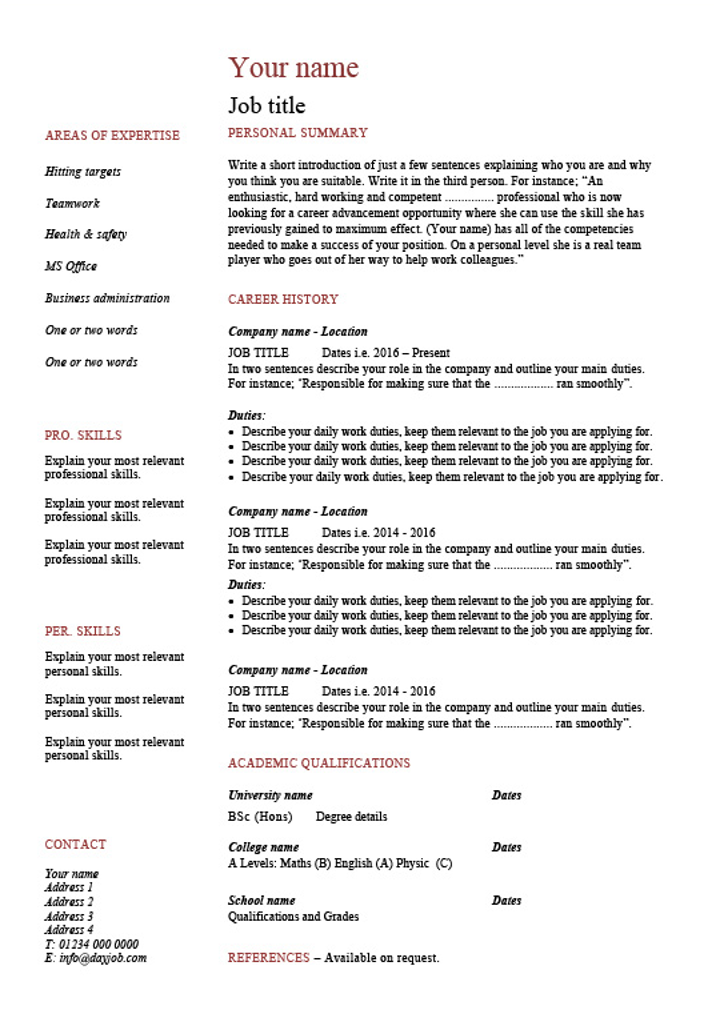
Example of a Generic CV Template
Source: https://www.dayjob.com/

Why It’s a Great Template?

The template you select for writing your CV depends on your experience, education, and position you’re applying for. Dayjobs template provides you with all the must-have sections in a CV. The font and color make it easier to read the CV. The structure of the template allows students to present information in a professional and easy-to-read manner.

How You Can Customize it

This template from dayjob.com presents you with a simple, clear, and concise way to display your information. It contains a section on the bottom right where you can add your contact information. Your contact information is essential because if you qualify for an interview, the recruiter will want to contact you.

The template’s personal statement section on the top allows you to tell your potential employer about who you are and why you think you’re perfect for the position.

You can take advantage of the career history section to talk about your work experience and key responsibilities or duties relevant to the job.

In the education section, list your schools and the dates you attended them, or you expect to graduate. To personalize it, add three or four bullet points on your achievement, qualifications, or memberships while in college or university.

On the right side of the template, you can list your relevant professional and personal skills relating to the position you’re interested in. Students looking for CV templates with no experience might also use this template to create their documents.

Should You Include A Picture on Your CV?

Hiring managers always scrutinize all the elements of your CV. Therefore, the decision of including your photo is important. The truth is, there’s no right answer to this question. But generally, it’s considered a bad decision to add pictures on CVs.

A photo in your CV can entice recruiters to skim your document. But it can also create an ambiguous unprofessional look on your CV. There’s also a high chance you might get discriminated against based on your race, gender, age, etc.

For some individuals, including a photo on a CV is standard practice. But for others, it’s entirely foreign.

The decision to put a photo on your CV can depend on the country you are applying to work in. Don’t include a CV photo if you’re applying for a job in the U.S., U.K., or Ireland since these countries have strict anti-discrimination and labor laws. But also, this depends on the job you’re applying for. If it’s modeling and acting jobs, you might have to add a photo.

If you’re applying for a job in Austria, France, Germany, Spain, etc., you can add your photo to your job applications.

To help you decide whether to add a photo to your CV, let’s look at some pros and cons of including CV pictures while applying for a job.

Pros of Including a Picture on your CV

You will save employer’s time

Most employers will search for your photo through the internet. By including your image in your CV, you can save them time. However, remember, they might still review your LinkedIn or Facebook account.

It can show you’re well-presented

The employee’s look reflects the employer’s business. In theory, most employers favour candidates who’re well dressed and neatly groomed. But this is a stretch since a CV photo can’t assure an employer that a candidate will always be well dressed and neatly presented.

CVs with photos receive more attention

As humans, it’s our nature to get attracted to images and other visual elements. So, a professional-looking CV photo can capture the attention of the recruiter and lead to your success.

Cons of Including a Picture on your CV

It can be used to discriminate

A picture on your CV could cause discrimination based on your age, gender, race, etc. Your CV should help you secure a job interview. It should not offer your employer a reason to ignore your skill or experience by focusing on how you look.

It’s unnecessary

Your CV accommodates all your skills, experience, and qualifications within one of two pages. When you add a photo, it will take up room and make your CV look unprofessional. Use the room in your CV to sell your abilities and expertise instead of your appearance.

Images are not ATS-Friendly

Many companies and organizations use the applicant tracking system to manage and filter CVs. Photos in CVs could confuse the ATS, which only reads text, preventing it from highlighting you as a top candidate.

Closing Thoughts

A great student CV is valuable since it’s your first and maybe only direct communication with your potential employer. Therefore, it should be thought-out, designed, and written so it can make an immediate positive impact on hiring managers.

You can customize existing templates to match your profile and create a CV or resume that spells out your experience and skills and help you stand out from the competition. If you desire more information and additional resources on creating a great CV, consider visiting GrabJobs. At GrabJobs you can also find student jobs in Singapore that might be suitable for you to apply for.


Career as a Pharmacy Technician – What Skills Are Important?

two pharmacist having customers Featured Image For:Career as a Pharmacy Technician - What Skills Are Important?

To be successful in any work, one must have the necessary abilities. Some abilities are built into a person’s nature, while others are developed through education or on the job. Pharmacy technicians, who play an important part in the healthcare business today, must have a diverse skill set in order to efficiently run the pharmacy and assist patients with their medical needs under the direct supervision of a pharmacist. With the advancement of technology, various technical skills, such as proficiency in OP Robot and Bar-Code Station software, must be taught over time. Before we get into the specifics of pharmacy technician abilities, let’s understand more about a pharmacy technician. 

What is a Pharmacy Technician?

Pharmacy technicians are medical specialists who work alongside pharmacists to assist and support patients and ensure they receive the best possible treatment. They work in places like pharmaceutical production or sales in the pharmaceutical business, community (retail) pharmacies, prisons, hospital pharmacies, and primary care, education, military, or veterinary offices. Each location has various tasks for pharmacy technicians, and each state has its own restrictions regarding what a pharmacy technician can do.

Today, Pharmacy Technicians have become an essential part of the healthcare team. Pharmacy technicians are essential in the delivery of medications to patients. Currently, pharmacists’ jobs are evolving from drug delivery to health care providers. As the pharmacist’s function evolves, pharmacists are now actively involved in patient care management. As a result, the function of the pharmacy technician is changing dramatically. Pharmacy technicians will be called upon to fill in the gaps and take on new responsibilities in the medicine delivery process. According to the Bureau of Labor Statistics, the pharmacy technician occupation is projected to grow 4% from 2020 to 2030.

Assisting a pharmacist dispense prescription medication may appear to be a simple operation, but it necessitates extreme precision and expertise. Pharmacy technicians ensure that drugs are dispensed appropriately and within a certain time frame. They, unlike pharmacists, are not the exclusive dispensers of drugs. They generally help with measuring, mixing, counting, and labeling prescription amounts. In addition, pharmacy techs often do not advise patients on proper prescription dosages and side effects in the same manner that a pharmacist does. 

Let’s dive a little deeper into this. 

Duties of a Pharmacy Technician

  • Working at a pharmacy on the front lines, assisting patients, answering phones, and interacting with medical personnel.
  • Checking the prescription, processing it, and giving the drug to the patient.
  • Informing the pharmacist or assisting physician of any adverse effects.
  • Enabling patients to communicate with insurance companies, doctors, and nurses.
  • Keeping both paper and computerized patient records.
  • Examining pharmaceutical supply to determine inventory.

Skills You Need to be a Successful Pharmacy Technician

Have you ever imagined yourself wearing a white lab coat and assisting folks in need? You certainly can as a pharmacy technician! However, before you begin applying for jobs, you need to assess your skill set.

What qualifications do you currently have on your resume? The correct set of skills might help you stand out from the crowd. As a result, you will have a better chance of obtaining a career that you enjoy. In fact, the job picture for pharmacists appears to be brighter than it has ever been. By 2026, the overall number of pharmacists employed could rise by nearly 18,000 positions.

You’ll need to hone your abilities if you want to be a good pharmacy technician. Developing the necessary skills can help you advance in your work. Set yourself up for long-term success in your job! Here are some key abilities you must have before applying for pharmacy jobs. With these abilities, you will be able to give the finest possible care for the patients you assist.

#1 Customer Service Skills

To be a good pharmacy technician, you must also have excellent customer service abilities. Every day, you will assist a number of patients. In reality, there are just six pharmacists on the globe for every 10,000 individuals. People rely on pharmacists like you to provide them with medical assistance.

As a pharmacist, you must be able to match a name to a face. Keeping your patients in mind will help you avoid costly blunders. Otherwise, you risk giving the wrong drug to the wrong patient. As a result, they may encounter side effects or drug interaction. Remembering your regular visits might also make your patients feel more welcome and valued. This way, you can form significant bonds with the people you encounter. 

To provide excellent customer service, you must be able to listen to each patient’s worries and demands. You must provide service with a smile and remain calm if someone else is upset. Keeping this in mind, patience is essential. Otherwise, you may find it difficult to remain calm in a fast-paced atmosphere (such as a hospital pharmacy). Developing good customer service abilities will assist you in projecting the image of a trustworthy specialist in your job. 

#2 An Eye For Detail

Before dispensing prescriptions, you will need to consider the well-being of others as a pharmacy technician. As a result, meticulous attention to detail is essential. Sweating the minor details can help you keep patients safe. Otherwise, you run the risk of making a critical error when synthesizing drugs or filling prescriptions. Giving the wrong medication to a patient could have serious effects. And in case their existing situation deteriorates, It could turn out to be a lot more than a little hassle.

You’ll need to pay close attention to detail to keep up with the aforementioned duties of a pharmacy technician. Otherwise, you risk making an important error when keeping records or distributing prescriptions. It also helps to have a good memory. To put things into perspective, you’ll need to recall several medications as well as patient information. Before you can pass your certification exam, you’ll need to know the most regularly prescribed drugs as well as their generic names.

#3 Proficiency in Mathematics and Technology

Developing a talent for math and technology can also help your career. Math will not be a problem for a competent pharmacy technician. To ensure accuracy on the job, you must be experienced working with numbers.

You’ll also spend a lot of time counting pills. Strong math skills can help you avoid costly mistakes. On the job, you will be required to use a variety of computer software tools. These applications and software will assist you in keeping track of prescriptions and customer records.

#4 Adept Pharmacology Knowledge

The study of how pharmaceuticals or treatments function within the body is referred to as pharmacology. This is a biomedical discipline of science that studies the effects and side effects of drugs. To execute your job effectively as a pharmacy technician, you must have a basic understanding of pharmacology. They will be handing out prescription medications to consumers and will be required to explain how the medication should be used. This will include the medication’s dosage and frequency of use. When dispensing medication, pharmacy technicians must also explain the basic adverse effects to the customer. The doctor should have already gone over this information with the customer, but it is the responsibility of the pharmacy technician to review the information as they hand out the prescription.

#5 Empathy & Compassion

Remember, you’ll be spending a lot of time one-on-one with patients and consumers every day. You’ll need compassion in addition to good customer service skills. Consider what your patients go through on a daily basis. You can put them at ease by assisting them.

You could assist folks suffering from either short-term or long-term diseases. In either case, your kindness can make a difference in their lives. Patients will feel more at ease if you show them compassion. Sick people aren’t usually in the best of spirits. Many of the patients with whom you encounter may be under stress. Perhaps they, too, have lately gotten dreadful news regarding their prognosis. You can assist these patients to relax as a pharmacy technician.

#6 Ability to Solve Problems

If you want to be a pharmacist, you should work on your problem-solving abilities. You’ll need to order inventory, configure a printer, contact insurance companies, and more. Learning how to deal with many challenges will assist you in meeting a variety of obligations on a regular basis.

As a pharmacy technician, you’ll need to be able to work quickly. It’s critical to learn how to keep a cool head under pressure. Otherwise, you may find it difficult to cope with the stress. It can be beneficial to learn how to prioritize specific chores. It is advantageous to have good multitasking abilities. Working more efficiently can be aided by multitasking. You can keep faultless accuracy while still demonstrating your organizing abilities.

In Conclusion: Do You Have the Healing Hands of a Pharmacy Technician?

Do you already possess these six vital skills? Great! You can become a successful pharmacy technician and take the profession by storm.

As more pharmacy jobs become available across the country, these abilities can help you stand out. So, are you looking for a job as a pharmacist? We’re here to assist you.

Did you love this post? Don’t forget to share it with your friends who dream to become pharmacy technicians. 

About the author

Megan Bosa, CPhT has been a certified pharmacy tech for the past 3 years, with extensive experience in a hospital pharmacy. She lives in the Midwest and is an avid marathon runner.

Hobbies and Pursuits That Help You Build Job Skills

a person holding a vase Feature Image For: Hobbies and Pursuits That Help You Build Job Skills

Hobbies are popular because they’re more than mindless pursuits. Hobbies typically involve activities that are extracurricular (i.e. not part of your job or other responsibilities) that give you a personal benefit.

For instance, there are a number of benefits that hobbies can offer, from better sleep and physical health to lower stress, improved relationships, and greater overall happiness.

Another unexpected benefit of a hobby is the fact that it can stretch your brain and help you develop new skills.

Finding Skills in Your Hobbies​

Any hobby can help develop skills of one sort or another. However, honing an applicable and beneficial skillset through hobbies takes a little strategizing.

It’s important to start by defining what it means to develop a “skill.” These are typically broken down into two or three categories:

  • Hard skills: These are applicable skills that are acquired through learning and practice, such as creating a spreadsheet, fixing a car, or kicking a ball.
  • Soft skills: These are nuanced abilities and attributes that tend to involve human interaction, such as listening, collaborating, and being empathetic.
  • Transferable skills: These are skills, hard or soft, that can travel with you from one job to the next.

Every hobby has a plethora of related skills. The important thing is breaking down each hobby to discover which skills are present and how they can apply to your career.

Incorporating Hobbies Into Your Resume​

Hobbies can be an instrumental part of showing an employer that you have a well-rounded set of skills that apply to a particular job. Of course, developing a skill via a hobby is only half the battle. 

You also need to communicate that information to a potential employer — especially if you’re trying to get a new job. In order to do this, you have to include the right hobbies (and their related skills) on your resume in a tasteful way that helps you stand out to recruiters. A few ways to do this include choosing hobbies that are:

  • Relevant: Consider each position and then include hobbies in direct response to qualifications listed in the job advert.
  • Restrained: Don’t list an abundance of hobbies; instead, choose two or three highly applicable options per application.
  • Non-polarizing: Stick to skills; don’t highlight highly opinionated hobbies, such as political activities.

When you add hobbies to a resume, briefly include them in their own section at the end.

Hobbies That Build Job Skills​

So far we’ve dug into how to identify skills in your hobbies as well as how to showcase them on a resume. Now it’s time to dig into some samples of hobbies that have particularly high inherent value when it comes to developing career skills.

Volunteering​

Volunteering is an iconic hobby — and one with many skill-related benefits. Soft skills are particularly important here.

Volunteering can take many different forms, but in most cases, it involves those who are in need. This is a great way to develop empathy for others. It also sharpens emotional intelligence and the way that you perceive and react to others’ feelings.

Volunteering also often puts individuals in positions where they have to improve their decision-making ability. This gives them an added dimension of decisiveness in the workplace.

You can also become a better servant leader by volunteering. Improving your ability to offer service to others can help you lead teams, care for clients and vendors, and even help with things like customer service.

Music and Art

Activities like playing the guitar or painting a picture are poster children for the “hobby” concept — and for a good reason, too. 

Both activities involve deep levels of creativity and inner passion. The ability to harness this and express it outwardly can be a difference-maker for many jobs.

In addition, participating in the arts demonstrates that you’re willing to cultivate yourself inwardly. You aren’t purely focused on outward-facing, shallow pursuits. This can directly translate to greater loyalty and trustworthiness.

Sports

Sports come with an endless list of benefits — even when they’re approached as an extracurricular pursuit. 

For example, participating in a group sport, in particular, can increase your ability to operate as a team player. It gives you opportunities to get better at communicating and coordinating with others. 

In some cases, team captains and coaches also have the chance to get better at managing groups of people. People management is an essential part of many job descriptions.

Video Games

It’s hard to look at something as casual as a video game as a bonafide hobby — let alone a skill-builder. And yet, gaming has become a powerful way to improve your professional capabilities.

In a tech-first world, the ability to play both creative and competitive games can help with a variety of important skills. This starts with obvious items like hand-eye coordination, but it goes much further.

Playing games naturally develops skills like critical thinking, strategic planning, and problem-solving. It also often puts you in situations where you must exercise social skills and collaboration.

At times, games can even push individuals to dip into areas like leadership and conflict resolution.

Blogging and Podcasting

Running a blog or creating a podcast may feel cathartic. It can also serve as a way to offload your thoughts and build your personal brand. But curating a blog can also be a great way to improve your work performance and help you land a good job.

For instance, both blogging and podcasting demonstrate self-discipline. They show an ability to create content and post it consistently based on your own initiative.

The activities are also a thorough demonstration of your ability to express yourself in both written and audible formats. This shows the ability to communicate through different mediums.

Managing a podcast or blog also requires a certain degree of business savvy. This can develop entrepreneurial inclinations and help you gain confidence with business decisions that involve risk.

Gaming

Video gaming is a great way to develop skills, but traditional gaming also comes with its fair share of skill-happy improvements.

For instance, strategic games like chess, Settlers of Catan, and any number of other board gaming options can develop critical analysis. They teach important differences in areas like strategy and tactics — with the former being about methods and long-term goals and the latter focusing on the specific actions and activities used to fulfill strategies. Naturally, these skills can translate into important business savvy.

In addition, while not officially a “game,” putting together puzzles is also a great way to develop skills. It shows that you can remain organized when working toward a goal. It also helps you learn to picture a goal and attain it. If you take things to the next level with competitive puzzling, it can also help you stay organized and goal-oriented under pressure.

Gardening

Gardening is one of the oldest hobbies in existence. It is slow-paced, requires patience, and is a deeply physical, rewarding activity. It also involves several nuanced attributes that can help you become better at your job.

For instance, a garden forces you to learn to slow down and smell the roses — literally. You must learn to move at the pace of your environment, even if you’re focused on the results. Learning to pace yourself in this way can lead to great success when you find yourself in a work environment that’s out of your control.

On top of that, gardening is a detailed activity. From irrigation techniques to weeding to plant placement, it’s important to consider how you lay out and manage your garden. This can be a great way to see how details in the here and now impact the end goal.

Cooking

Cooking is another age-old hobby that attracts many people. From learning the basics to digging into cultural styles, there’s a lot to learn in the kitchen.

The skills you learn while cooking can also build job skills in a variety of ways. This starts with time management. If you can’t follow the right timing, it can ruin many a dish. This can directly translate to a field like accounting, where managing time can make a huge difference with things like paying taxes or fulfilling invoices on time.

In addition, following detailed instructions can be the deciding factor between culinary success and failure. And learning to add your personal flair without breaking the “laws of the kitchen” only takes that skill to the next level.

Reading

Last but certainly not least, we have reading. This is one of the most common hobbies in the history of mankind, and it’s not hard to see how it can impact your job performance.

Reading cultivates your ability to conduct research. It teaches you to pursue and process knowledge.

It also feeds an insatiable desire to always be learning. This resonates strongly with the growth mindset prevalent in so many modern offices.

Perfecting Your Professional Pursuits Through Hobbies

There are many reasons to use hobbies to hone your professional skill set. 

You might be just starting out and looking for ways to beef up your resume with some applicable experience. You might find yourself shifting to another position within your field. You may even be trying to change industries entirely. 

Regardless of the reason, don’t miss out on the opportunities that your hobbies present to help you build your job skills. Identify the skills inherently present in each of your hobbies and then look for ways that they can help you, both in your current job and in any future positions you might hold.

About the author

Amanda Winstead is a writer from the Portland area with a background in communications and a passion for telling stories. Along with writing she enjoys traveling, reading, working out, and going to concerts. If you want to follow her writing journey, or even just say hi you can find her on Twitter.

Building Your SEO Career From Scratch

letters on white background Feature Image For: Building Your SEO Career From Scratch

In this digital world, many industries have changed, especially in digital marketing.

SEO is a very important contribution to digital marketing and is expected to experience significant growth in recent years. With the advancement of this technology, the demand and demand for SEO professionals and other marketing technologies have also been observed.

SEARCH ENGINE optimization is one of the best ways to increase the quantity of traffic on a site with search results.

This can help improve your website’s visibility for related queries. By presenting yourself well, you attract the attention of your audience and create potential buyers for your company.

What does SEO do?

Entrepreneurs, without being part of it, start producing a lot of content for articles, blogs, etc. It’s hard for you to create content that gets your audience up and running. With SEO, you will start by following a few lines to increase your page rank.

These guidelines include the use of keywords on all of your pages and website so that users click on those keywords in search engines, to rank your pages.

Working with SEO

There are many SEO career opportunities in which you have to work mainly with two concepts: generating relevant keyword content and creating good quality backlinks to your business site.

For every keyword that users enter into a search engine, it has a relevancy index, which results in a quick index view and provides users with the results they need.

When searching for users, search engines, including Google, use spiders that search the entire web directory. Additionally, backlinks allow Google bots to detect content that you have posted while crawling authoritative websites.

The SEO job description requires not only the ability to generate backlinks from certain authoritative and relevant websites, but also the ability to generate feedback from multiple domains.This can quickly improve your content ranking and increase traffic.

When pursuing a career in SEO or any other field/job, you must remember that the efforts you put in will not pay immediate results. Just as a seed of this type does not immediately turn into a tree, it takes time for its contents to begin to rank. Any changes you make to your site based on your research will be reflected after a while.

Review the detailed interview questions to help you prepare for SEO interviews.

Career opportunities in search engine optimization

You may be wondering, when you are trying so hard and working hard on SEO, ‘Is SEO a Good Career Choice?’ Yes sir. SEO is a good career choice because it is the most sought-after career in digital marketing.

There are several organizations around the world that are hiring SEO experts to create better content and thereby generate more business contacts.To move forward in this area, we will work directly with stakeholders to help slow business growth.

Additionally, you’ll work closely with your company’s marketing team to make sure the content is in line with your goals and research. 

When it comes to SEO professions, you can learn how to use it.

Expertise to become an SEO expert

With the advancement of SEO, this has become difficult over the years. That’s why a job in SEO requires you to be an expert in a variety of disciplines, and businesses want it more than ever.

To find SEO jobs, you need to be a strong leader. The quality of your device will keep you abreast of the current market. Most search engines release multiple updates per year, and it can be difficult for businesses to keep tabs on what changes this shift may be affecting in the market.

You and your SEO skills will appear here and you can study your company’s website.

In addition, you will be deeply informed about digital marketing and the role of SEOs in it. You need to find all the skills you need to be an SEO expert. 

Depending on the technical requirements, you need to know GSC, GA and other Google tools.

With search engine algorithms constantly changing, as an SEO expert you should be able to troubleshoot a website and improve its visibility. 

To do this, HTML and CSS are all set to work in the area.Also, you need to know about META, H1 tags, legal numbers, etc., as well as the ability to troubleshoot typing issues.

These are the skills needed to get a job in SEO. Some of the skills you need to build a successful SEO career include skills like intelligence, thinking, research, simplicity, communication, etc.

There are several SEO opportunities that SEO experts can choose from. Some of the professional profiles that professionals with this skill set may require are as follows:

SEO specialist:

There are several SEO opportunities that SEO experts can choose from. Professional profiles that require this skill set are:

  • Digital marketing manager
  • SEO manager
  • Social media strategist
  • SEO intern
  • Social media manager
  • SEO analyst

SEO analysts want to improve your organic ranking on Google? So discover the best SEO tools used by SEO specialists. Now take a look at the different career opportunities on the path to the SEO career.

SEO Analyst salary

In marketing, the salary is highest for a career in SEO. Trained SEO professionals are in great demand around the world.

According to Payscal, the average salary for an SEO analyst is around $ 50,132 per year.

Wrapping up

We should not ignore what we can achieve through SEO. It is a great tool that could help your site be more efficient. Marketing and SEO go together so, if you are willing to take a career path into marketing you should be familiar with SEO. 

Interested in marketing? Grabjobs gives you more marketing articles and tips! Give it a look!

When To/Not to Explore Further Studies as Working Adults

two men talking and starring in their laptops Feature Image For: When To/Not to Explore Further Studies as Working Adults

The COVID-19 pandemic is severely impacting employment opportunities across different sectors. Many working professionals are considering exploring further studies to better their employment chances in this era of unprecedented job losses.

  • In 2020, there were over 114 million job losses across the world. Young workers account for 8.7% of these job losses.
  • Another global study by Microsoft revealed that 41% of working professionals were considering changing professions in 2020.

Get a new job or get a new degree?

Which decision is better for the modern-day working adult?

We feel both options can be positive choices, as long as your decision is well-thought-out.

Increases in the number of adults enrolling in college programs are common during major economic downturns. For example, after the financial crash of 2008, countless professionals realized the importance of further education in securing employment.

Since then, adult enrolment rates in higher education, certificate, or degree programs have continued to grow year every year.

Pursuing Further Studies as a Working Adult—Why it Makes Sense?

In the post-pandemic world, pursuing higher education or specialized degree programs can benefit working adults.

  • Competition: Now’s the perfect time for employees to update their education, particularly in digital technology. Risks of career stagnation and unemployment are higher for those who aren’t up-to-date with the latest advances in their fields.
  • Earning Potential: On average, a high school graduate earns 66% less than a bachelor’s degree holder. The same rule applies to masters’ degree holders, professionals with specific specializations, certifications, etc. Your earning potential directly correlates to your educational background.
  • Experience: Working adults with experience in specific industries know what degrees or certifications they need to obtain for career advancements. This experience enables them to pick specific, time-efficient courses that conveniently improve their employment potential.
  • Access: Thanks to online education and certification platforms, pursuing higher education has never been easier for active professionals. Professionals of all ages and industries can find and enroll in degree/certificate programs that guarantee to boost their CVs. Plus, several top online educational platforms are industry-accredited. These qualifications are not only accepted in modern-day workplaces—they often make all the difference for job applicants.
  • Career Changes: Earning another qualification is the best way to make complete career changes. Certifications make unemployed professionals more employable. We’re currently living in an era of career changes. Young professionals, in particular, are likelier to switch companies and fields. Having certifications and degrees makes modern-day professionals better suited for such a labor market.

Even when a job doesn’t specifically require a degree, 91% of these jobs go to degree-holders. That’s why the road to financial security and increased earning potential is almost always specialized, higher-level education.

Enrolling in higher education, certificate, or degree programs also gives working professionals to network with like-minded peers. Lastly, enrolment rates of adult learners across the globe are constantly increasing. 

Are You Ready for Further Education?

Many adults make the decision to pursue further education without thinking about which degree or college they want. This can be an expensive mistake. Signing up with online universities is less risky in this sense. Still, “aspiring students” must address the following questions to determine whether they’re ready for or really want further education:

1) Why Do You Want to Explore Further Studies? 

Most working adults want to complete their degrees as per their schedules and at reasonable costs. However, those aren’t goals. Are you sure what you’ll learn by going back to school will help your career? If so, in what ways. Having such clear goals from the start helps adults choose the right degrees and the right colleges.

2) What Career Options Will the Education Guarantee?

What kind of job/career do you desire? Which jobs have the most promising outlooks in the current labor market? If you don’t know the answers to these questions, you’re probably not ready to enter the world of higher education.

3) What Quality of Education do You Want?

Although today there are more educational options for working adults, there are also many fake colleges and universities out there. These “institutions” are only focused on making profits off of their students. Avoid such educational opportunities. Such programs typically award degrees that most employers don’t value during recruitment. 

4) Can You Afford Higher Studies?

Higher education can be expensive, even for working adults with fixed sources of income. That’s why before quitting your job for education, consider your costs. Look for flexible college programs that are designed for adults leaving the workforce. 

PS: Watch out for technology-based learning opportunities. Working adults with irregular can save time with online learning. Many online colleges even accept credits from previous institutes. That means students don’t have to repeat courses.

5) Can You Navigate the Admissions Process?

Walking through the steps of applying to colleges may seem alien to professionals. Steps like understanding deadlines for submitting applications or even filling out applications are confusing for adults re-entering colleges.

Many adults have unique financial opportunities that they must optimize. This may seem like the easiest challenge of all. But, many young professionals don’t do their due research before entering education programs.

For instance, military veterans receive many educational benefits that cover their school-related costs. Similarly, many companies offer free upskilling courses for interested participants.

In some tech education programs, professionals are paid for learning computer programming or other company-specific skills. Learn about these techniques and offers before starting your application process. Look for the most cost and time-efficient education opportunities.

Challenges Working Adults Should Expect 

Unlike “traditional” students, adult students often face unique challenges such as –

  • Financial Support: Adult students may have to secure separate sources of financing to pay for their advanced studies.
  • Time Hassles: Balancing personal or work-related commitments is much harder when you’re enrolled in education programs.
  • Self-Belief: It’s common for adult students to lack self-belief after re-entering education programs they’ve avoided for several years. They may also fear being left behind by younger students. Adults with poor social skills are likelier to fear getting ostracized and isolated during the application process. These fears may keep them away from exploring further studies.
  • Access: With online classes, access to educational institutes is much easier now. Still, some adults may have to change locations or travel long distances to access their desired courses.
  • Support: Traditional students receive plenty of support from their friends, social groups, etc. When you’re one of the few adult students in a program, it’s harder to find such support. That’s why adult students must look for support systems just as soon as they start their educational journeys. Proper support will help them overcome these apprehensions about education.

These are real challenges and insecurities that adults must consider before re-entering the world of education. If you’re not ready to address these challenges, you’re not ready to fully pursue further studies.

Many professionals take up educational courses on a whim without accounting for these realistic challenges. As a result, many abandon their studies mid-way and abolish all thought of pursuing higher education from then on.

Unlike the pandemic, the switch to education from work needs to be planned. The worst thing adults returning to college can do is not plan for these risks.

Test Your Resolve—Exploring Online Education as an Adult Student

The best way to eliminate most potential risks of returning to education is by taking part in online educational programs. Currently, many educational institutions are offering customized online programs for working adults. These programs are designed to simplify the process of obtaining degrees and certificates for working professionals. People who are unsure about quitting or halting work for education should try online education first. Opting for online education gives adults –

  • Time-Efficiency: Most online study programs allow students to work at their own pace. The asynchronous formats of the courses suit young professionals who need to schedule study time as per their time requirements. Online education also allows adults to meet their family responsibilities.
  • Easy Access: Adults can technically access their favored educational programs via their cell phones. Don’t have the time to travel to classes or the money to buy education-related gadgets? Online learning eliminates all these issues and allows working professionals to learn at their convenience.
  • Long-Term Cost-Efficiency: Most working adults who consider pursuing higher education have to be budgeting masters. They conduct complex calculations in their heads to determine how much they need to save for different education-related costs. That’s why non-traditional online educational programs are the more cost-efficient option for such adults. These courses demand fewer fees and are more time-efficient. They also don’t involve additional costs like travel, paying for campus rooms, etc.

Final Take

School, as an adult student, has many perks and risks. Online education has decreased the number of risks involved in the process. Worried about this transition? Start by enrolling in a low-cost online study program to understand how it improves your career prospects. For instance, take a six-month part-time certification course for starters. If this short-term experience proves beneficial for your career, making bigger transitions will seem easier in the future!

About the Author

This article was contributed by Digital Senior. If you’ve found this article useful, hop on over to the Digital Senior website for more resources on tertiary education and lifelong learning in Singapore! 

Essential Guide To Overcoming After Getting Fired

man adjusting his tie Feature Image For: ssential Guide To Overcoming After Getting Fired

“You’re fired!”

Those are two words that you never want to hear at your job. You especially don’t want to receive a pink slip saying that you can no longer work with a company that you’ve spent much time at. But if that happens, then you’re not alone.

It’s true that getting fired can feel like you’ve been betrayed by your employer. However, there’s a reason for everything, and getting fired from a job isn’t a stranger to this fact.

In this essential guide, we will explore why overcoming this big change in your career is important, and then we will show you a list of things that you can do to overcome and find your next job.

Why You Must Overcome Getting Fired

While getting fired can feel crushing and hurtful, it’s important to adapt to the sudden change and overcome. In fact, knowing how to get over being fired can actually help you to move forward. Otherwise, you’ll feel terrible, and that’ll make finding another job more difficult for you. Instead, learn to overcome, so that you can grow both individually and professionally.

So, now that you know why overcoming is essential, here’s how you can overcome getting fired:

1. Take Time To Grieve

“First and foremost, getting fired from your job can take an emotional toll on you,” says Fiona Chandler, a business writer at Elite assignment help and UK Writings. “It’s never healthy to bottle in your emotions. Take some time to grieve.” There is no right or wrong way to grieve. Plus, there is no time limit on how long you can grieve. The point of grieving, however, is to feel better. Here are some things to keep in mind as you grieve:
  • Observe how you’re feeling. Are you feeling sad, angry, or depressed?
  • Observe what has changed since you got fired.
  • Observe what you’re doing now to try and overcome this sudden change.
Don’t ever let anyone tell you that it’s wrong to grieve. In fact, you have the right to grieve; and no one should ever take that away from you. Just as long as you step back out into the world again after a while, it’s okay to grieve.

2. Practice Self-Care

Now that you have more time at home, you can take some time to yourself. Eat your favorite foods. Watch your favorite movies and shows. Hang out with friends and family. Go for a walk. Buy yourself something nice. Or, curl up with a book that you’ve been wanting to read in forever.

Practicing self-care can help you to refocus on yourself, which might have been something that you’d probably didn’t have time to do when you were working. But don’t forget: Looking for another job is key so that you can continue to take care of yourself.

3. Know Your Wants And Needs

Once you pamper yourself for a while, think about what your next ideal job will look like. To do this, make a list of all the things that you want and need from whatever job you take on next. When listing your wants and needs, keep the following questions in mind:

  • Would you rather work in casual dress, or in uniform?
  • Do you want your next job to be laid-back or fast-paced?
  • Do you want your work schedule to be fixed or flexible?
  • Do you want to work at home, or be an in-house employee?
  • What types of perks do you want to see in your next job? (Full health insurance, maternity leave, etc.)

4. Look For Positives

Now, just because getting fired is a negative in itself, doesn’t necessarily mean that there’s nothing positive about it. Perhaps the long hours of that job were making you tired every time you came home? Perhaps you didn’t like the working conditions of that job? Or perhaps you felt overlooked by management several times during your employment?

In hindsight, this job loss might have opened doors to different (and better) opportunities. Remember: There’s always a reason for everything, even if you don’t see it at first. This would be a great time to reflect on what has happened so far.

5. Don’t Look For Comparisons

The last thing you want is to be sad and angry whenever you see other people with jobs and happy lives. Just because you’ve lost your job, doesn’t mean that you can’t be happy like everyone else. In fact, social media often instigates this sadness and anger, because you might come across people either bragging about their jobs, or just being happy without a care in the world. This can cause you to make comparisons between you and other people on social media, and make you feel ashamed that you’re “not like them.” So, if you feel that social media is becoming too much to bear since your job loss, then take a break from social media. Parade suggests that if you take a social media hiatus, then you’ll experience the following:
  • A little anxiety, before it goes away
  • Short-term loneliness, before you start to feel better
  • Better mental health
  • Better sleep
  • More productivity
  • Reduced stress
  • Boosted confidence
  • Better posture
  • Reduced eye strains, AND
  • More understanding of your emotions

6. Talk About It With Others

While it might be hard to talk about your job loss to others (including friends and family), it’s important to open up about your trouble at some point. It’s okay to take your time before talking about it, but don’t let the negative feelings eat away at you for too long.

You can even ask for feedback on what you can do as your next step towards other employment. Ask people you know about both your strengths and weaknesses. If there’s a recurring theme in the discussions, then it’s time to delve deeper (which we will talk about in a latter section).

7. Exercise

“Exercise can help you take your mind off the negative, and help you focus on the positive,” says Donna Hitchcock, a marketing blogger at OX Essays and Revieweal. “While it’s tempting to curl up in bed due to how depressed you might be, that can actually zap a lot of energy out of you before you can even start the day. That’s why it’s important to get moving in any ways possible.” Consider doing exercises that are easy for you to do. Don’t ever do exercises that you can’t do. The last thing you want is to get injured doing a difficult exercise. When done right, exercise can help you stay energized throughout the day, and help you feel well no matter what to do.

8. Set SMART Goals

When it comes time to get back on your feet, be sure to set some goals. All any goal will do, it’s important to set some SMART goals, which go as follows:

  • Specific – Where you narrow the focus on the goals that you jot down
  • Measurable – Where you figure out how you’ll measure the progress of said goals
  • Attainable – Where you create realistic goals for you to accomplish.
  • Relevant – Where you ensure that your goals make sense in what you want in your life and career; AND
  • Time-bound – Where you set doable deadlines for your goals

9. Look For Ways To Improve

Don’t ever assume that your formal boss is to blame for you being fired. Chances are, you might not have performed in a way that would’ve been okay with him or her. Understand why your boss had made the decision to fire you. Were you coming into work late? Were you missing deadlines? Were you having issues with coworkers? What made your boss fire you?

You can even ask your former boss to elaborate on why you got fired. In this way, you can improve the areas that had gotten you fired in the first place. Improve, so that you won’t make that same mistake in your next job.

10. Thank Your Former Boss

No, really!

Once you come to terms with the job loss, it’s important to get closure from your former employer, so that you don’t stay mad at him or her.  By getting closure, you’ll feel better about the job change, and even grow to respect your former boss’s decision to let you know from the company.

One of the best ways to have closure is by writing a simple letter or email to your former employer. Keep it short and sweet, and don’t bring up anything negative. In essence, your note should look something like this:

Dear [Name of your boss],

I would like to take the time to thank you for the experience and opportunities that I was given while I worked with you at [Name of Company]. The role gave me many learning opportunities, and I am confident that the skills learned from this job would help me in the next step in my career.

I wish you well in the future and much success at [Name of Company].


Best regards,

[Your Name]

Conclusion

As you can see, it can take time to get over a firing. However, by taking care of yourself, and getting back into the job market, you’ll feel better about that change in your life. We hope that this guide will help you to get back on your feet, and help you find another job with confidence.

Good luck!

About the author:

Christina Lee is a writer and editor at Big Assignments and Custom essay. She is also a contributing writer for Best essay writing services. As a project manager, she oversees many writing projects in various companies nationwide. As a content writer, she writes articles about marketing trends, job search, employee etiquette, and lifestyle trends.

Before You Accept The Job: Benefits About the Position

a person taking notes Feature Image for: Before You Accept The Job: Benefits About the Position

Many people don’t hesitate to accept job offers immediately. This excitement often limits those who have done or will do this because they don’t fully understand the features of the position. You may not know yet about the list of benefits about the job position you were offered. It’s common for people to want jobs that come with extra perks that can be seriously helpful in their life. Before you send your job offer acceptance email, ask about what benefits are included. Knowing exactly what your job includes can prevent you from accepting positions that lack benefits. Here is what benefits to ask an employer about for any job position you have been offered.

Job benefits are extra things that come with job positions. These benefits may include health care insurance, free work trips, flexible schedule opportunities, and more. Having a job with benefits can help individuals in the long term. Money can be saved, and working will be more worth it if you can obtain a job full of extra advantages.

Types of Job Benefits

There are an array of benefits included in modern jobs. These are the most common types of job benefits you’ll see today.

1. Insurance

This benefit is probably one of the best on this list. There are jobs that provide employees with insurance. Here are the types of insurance that are included in certain jobs.

  • Health Insurance

Having health insurance is a beautiful thing. Even if you live in a place with free healthcare, not everything is covered. If you don’t have an abundance of money to cover the cost of health issues you end up in, having health insurance can remove any worries. Jobs that usually come with health insurance include teaching, government positions, and even some entry-level jobs like being a barista at Starbucks. Research jobs that are available in your area and see if they offer health insurance. This perk can be more common than some people realize.

  • Dental Insurance

Even quick trips to the dentist can be pricey. Dental insurance can help you avoid paying for teeth cleanings, fillings, and removals. Some jobs even help you cover Orthodontic care like getting braces and headgear. Be cautious though, because if your job includes this benefit, it may require you to change your dentist through the plan.

  • Vision Insurance

Eye checkups, prescription changes, contacts, and a new pair of glasses aren’t cheap. Vision insurance can cover these costs, and depending on the plan, even certain eye surgeries as well. Similar to dental insurance, vision insurance plans through your job also may require you to switch to a new eye doctor.

  • Life Insurance

Just in case of an employee’s death, some employers invest in life insurance for their employees. Especially for more dangerous work fields, life insurance is a common benefit that comes along with these hazardous jobs. Having life insurance relieves employees of worrying about family members dealing with their finances if they do pass.

  • Disability Insurance

This insurance covers days off if you end up having a disability while working at a job, or you are currently dealing with a disability. Employers may provide this insurance as an option, so that those with disabilities can get paid if they can’t always be at work. Disabilities may include mental health issues, down syndrome, paralyzation, autism, and more.

If you are needing or wanting a specific type of insurance, don’t be afraid to ask your potential employer if they include it in your position. Getting a job with insurance is a wonderful way to get extra support along with the money you earn at a job.

2. Paid Time Off

We all deserve and need time off of our busy work schedules. A common factor that prevents people from taking time off is not getting paid while on vacation. Many people can’t afford to lose that money, so they have no choice but to keep working their regular schedule. Fortunately, there are jobs that do exist that pay their employees for their time off work. If you want or need that benefit in a job, make sure you ask if it is included in a position before you accept it.

3. Flexibility

Everyone is not capable of working a strict, unchangeable, work schedule. There are a variety of jobs that are built around flexibility. If you are looking for a flexible job schedule, focus on searching for jobs that include that feature in the job description. If you are being interviewed for a job and you don’t know if they offer flexibility, ask the employer about it. Some employers can allow you to have a flexible schedule if needed, even when the other employees work a strict schedule.

4. Discounts

Getting discounts off of a company’s products and services is a benefit that entices many people to work at a specific job. If you want to save money on items or services you regularly purchase, choosing a job with discounts on those things is a great idea. Especially for teenagers and young adults, getting an entry-level job at clothing or other retail stores is wonderful. Employee discounts are included in essentially every job that sells products of any kind.

5. Work Environment

The location of a job position can also be part of the perks that are included. You could be in a relaxing, cozy office space that is chilled and laid back. You could have opportunities to switch buildings if you want a change of scenery. Some workplaces provide free snacks and meals to keep employees energized and happy. In order to avoid a work space where you won’t be able to thrive in is important. Another thing to consider is how far the work space is. Knowing this information is helpful in order to prevent you from accepting a job that is inconvenient and too far away from where you live. You can avoid poor work environments by making sure you check to see how the space of a job exactly operates. “Treating new and current employees as equals is morally correct when growing a company,” says Tim Baker, HR manager at Paperfellows and Boomessays.

6. Promotions

Depending on the type of job, there could be several levels of promotions you can reach. If you are looking to build up in a job field, search for jobs that give employees the opportunity to reach promotions. You deserve to get promoted when you have exceeded certain levels of work.

7. Wellness

The wellness of employees is important to the success of a workplace. All jobs should offer wellness benefits, but not many actually have these options. Wellness benefits include things such as physical health, mental health, and checkups. If these areas are important to you, it isn’t a bad idea to request this benefit if it isn’t already offered in a job position.

8. Education

Learning while working at a job, and gaining quality experience is a great investment. Check to see if jobs you are offered include coverage for higher education, and prioritize learning within the position. Some employers help pay tuition costs, have scholarships, and pay for further training for your job.

9. Retirement Plan

If you want to work at a job for years on end, you better look into the retirement and pension plans of the position. If you want to have money for retirement, don’t accept or stay at a job that doesn’t offer retirement plans. Make sure that you are able to get enough money to retire through your job. This benefit is highly necessary, especially if you have yet to start saving for your retirement. “Anyone can think of a great topic, but it doesn’t mean they can write a perfect essay,” reveals Anna Burnes, writer at Essayroo and Oxessays.

10. Child Care Assistance

Whether you are a single parent or not, child care assistance helps many families out. Many parents work busy schedules, preventing them from having time to properly care for their children. More often than not, these families don’t have the money to hire babysitters. This is because they are working endless hours to afford the costs of raising a family. This is why getting a job with child care is of utmost importance if you are in a similar scenario. There are jobs that assist struggling parents so they can afford child care.

11. Recognition

Joining a company that truly values their employees is in your best interest. Nobody wants to suffer working in a toxic environment where they get treated inhumanely. If something is off when you get offered jobs or are being interviewed, listen to those red flags. Doing further research into a company and their values is also a good idea. Confirm that the company is genuine about how they treat their workers. Also, check to see if past employees have given reviews and feedback about their experiences. Remember to use trustworthy sources, and make sure the company you want to work for is honest. Getting recognition as a hard-working employee is important and ethical. Make sure you don’t end up in a harmful workspace.

Reflecting on The Benefits

You may get offered a position that doesn’t offer each and every benefit you are looking for. That is okay as long as you are satisfied with the benefits you do receive. Obviously, it’s rare to get a job with every benefit on this list. The important takeaway is to get the benefits you truly do need if possible.

About the author:

Emily Henry works at Ukwritings and Custom Essay. Emily writes about the benefits and perks of creativity. She also blogs at Essay Writing Service.

Top 10 Transferable Skills Employees Need to Succeed

a person taking notes from his computer on the desk Feature image for Top 10 Transferable Skills Employees Need To Succeed

Constantly evolving job markets force employees to continuously update their skillsets to remain competitive. Likewise, switching from one career path to another often requires an entirely different set of abilities. However, there are certain skills that are valued by employers across all industries.

The World Economic Forum recently released a report that explores the future of jobs after the recent disruptions caused by the pandemic on the labor market. They use quantitative and qualitative data from the private and public sectors across several industries and countries to paint a clearer picture of the future of employment. Based on the opinions of business leaders, they identified a list of ten transferable skills that employees need to succeed during the Fourth Industrial Revolution.

Transferable skills are abilities, talents, and expertise that are beneficial for any profession. Employees can easily transfer these skills from one career to another. These skills can be acquired from your job, school, volunteer work, and even your hobbies.

Transferable skills can be soft or hard skills. Soft skills, which are difficult to measure, such as emotional intelligence tend to be more common as transferable skills. However, some hard skills such as fluency in a foreign language can be transferable as well. 

Why Are Transferable Skills Important?

It is important to include transferable skills in your resume because they could distinguish you from other candidates for that role. Transferable skills are considered to be an asset regardless of the position you’re applying for. This means employees with transferable skills will find it easier to transition from one career field to another. “Transferable skills are particularly valuable if you’re unsure of your current career path and are considering another one,” advises Helen Price, a career blogger at Draft Beyond and Writinity. “Having these competitive skills can help you transfer from one industry to another.”

Transferable skills tend to be useful outside of work as well. Skills such as communication, emotional intelligence, and creativity can be applied to improve other aspects of your life beyond your career. Since transferable skills can be developed outside of work, employees can practice and hone these skills regardless of their profession.

Top 10 Transferable Skills For Employment In Any Industry

According to the report by the World Economic Forum, these ten transferable skills will help employees adapt to the Fourth Industrial Revolution. In this new age that combines the physical, digital, and biological, employees who wish to stand out should possess the following transferable skills.

1. Creativity

Creativity is one of the most valuable yet underrated skills in the workplace. Many people mistakenly assume that it’s an inherent talent that only some possess, but in reality, everyone has the capacity for creativity. If you identify as someone who isn’t creative, chances are, you simply don’t practice it as much. While it’s true that some exhibit more talent in certain creative endeavors than others, creativity, in general, is a transferable skill that can be developed. When you generate a new idea, devise a clever strategy, or solve a complex problem, you use your creativity. Many employers value creativity because it encourages employees to discover patterns and form connections when approaching their work. Moreover, creativity is necessary for innovation, and companies need to continuously innovate to remain competitive.

“People often misjudge creativity as a skill that is exclusively valuable to professions in the arts,” observes Stanley Lesser, a writer at Research papers UK. “Yet various industries require their employees to come up with creative solutions, approaches, and ideas.”

2. Emotional Intelligence

More and more hiring managers are prioritizing emotional intelligence when filling roles within their companies. This is largely due to the benefits of having an employee with high emotional intelligence. Those with high emotional intelligence or emotional quotient (EQ) are better able to manage their emotions and respond to the emotions of their coworkers and clients. Employees with high emotional intelligence offer employers their ability to communicate sincerely, empathize with coworkers and customers, as well as calmly approach stressful situations. This fosters greater collaboration and better relationships among employees. As a result, many companies look for this transferable skill in their employees.

3. Critical Thinking

Critical thinking is a constantly sought-after skill in every industry. This skill enables you to make well-informed and nuanced conclusions based on all the available information. Employees who possess critical thinking skills are more adept at understanding a problem and its consequences fully. They are also able to devise solutions based on their analysis and implement it effectively. Many organizations rely on the critical thinking of their workers to operate efficiently. Critical thinkers can also help them optimize processes, reduce costs, and develop solutions to complex issues. Thus, many hiring managers look for candidates with this transferable skill.

4. Complex Problem Solving

Complex problem solving draws on transferable skills such as creativity and critical thinking to approach issues. Novel problems on the job are almost certain to arise in today’s world and employers want to ensure you have the mental dexterity to tackle them. Those with complex problem solving skills can observe challenging issues objectively and implement well-informed solutions and strategies. They are able to thoroughly comprehend the consequences of various solutions before they apply them. Furthermore, employees with complex problem-solving skills are better able to identify the root cause of an issue and determine the optimal solution moving forward.

5. Cognitive Flexibility

Cognitive flexibility determines how well you can adapt to your new work environment. This skill is defined by your ability to multitask and course-correct. Those with a high degree of cognitive flexibility can adjust as needed to any unforeseen changes in an environment. Moreover, they can easily switch their approach and modify their strategy in response to these changes. Many employers appreciate this transferable skill in this rapidly evolving world. Employees with cognitive flexibility can not only adjust faster to their new roles and work environments, but they will also respond better to any changes implemented by the company.

6. People Management

As one of the few skills that cannot be automated, people management is an extremely useful transferable skill to put on your resume. Managers understand better than anyone the challenges of overseeing other employees, and thus, recognize the importance of this skill in their applicants. Those who possess people management skills offer a lot of crucial expertise to organizations. They can skillfully communicate with other employees, empathize with them, and understand how to maximize their potential. They are able to motivate others, increase productivity, and encourage others to meet the desired goals of the organization.

7. Judgment and Decision-Making

Employers need workers with excellent judgment and decision-making skills to ensure decisions are aligned with the company’s values and overarching vision. Furthermore, as the data available to businesses increase, they need people who can make sense of the vast amount of information, analyze it, and help them formulate well-informed strategies and decisions. Employees who can weigh these decisions, reach practical conclusions, and present objective recommendations are necessary for the success of a business. The judgment and decision-making skills of individuals ultimately determine the future of a company. Therefore, many companies require applicants to have these transferable skills.

8. Coordinating With Others

It’s clear why companies would look for employees who can successfully coordinate with others. Collaboration and teamwork are important aspects of any workplace. The better employees can communicate with each other and work together, the better it is for business. Companies want employees who can coordinate well with others because it boosts productivity, promotes the exchange of ideas and expertise, and results in happier employees. Therefore, the ability of employees to coordinate with others can determine their experience in the workplace and the success of a business.

9. Negotiation

Understanding how to negotiate with people is a very valuable transferable skill that can be advantageous in numerous fields. Finding a mutually beneficial solution is extremely important in business. The skill to negotiate well contributes to the success of a business because they develop better relationships and eliminate the chances of conflict. Clients and other companies are more likely to do business with you again after a good negotiation. Likewise, bad negotiations can negatively and permanently impact business relations. Thus, companies need employees with good negotiation skills to build and maintain strong relationships as a business. 

10. Service Orientation

It’s no surprise that customer service is a highly valuable skill to customer-centric businesses. With more competition than ever, businesses must provide excellent service to consumers in order to survive. Employees with the skills to anticipate the needs of consumers and cater to those needs in order to ensure customer satisfaction are incredibly valuable to companies. Similarly, employees who understand their ideal consumer well are necessary for a business to thrive.

Conclusion

With the Fourth Industrial Revolution upon us, it is more imperative than ever for employees to learn skills valued across all industries. These ten transferable skills will allow workers to switch between career paths as they please or whenever necessary. With labor markets highly susceptible to disruptions, practicing any of these skills could help ensure you never struggle to find employment. 

About the author:

Jenny Williams is a hiring manager and content specialist at Case study writing service and Law assignments. She also writes about career tips and strategies for Gum Essays service blog.

What are 11 the Greatest Challenges the Virtual Teams are Facing Now?

a laptop on a desk with an open screen from a meeting Feature image: What are 11 the Greatest Challenges the Virtual Teams are Facing Now?

Virtual teams have been around for a long time but they became wildly popular in 2020, partly due to the movement restrictions that were put in place to curb the COVID-19 pandemic. In fact, some companies have been using virtual teams successfully during the pandemic to boost their efficiency and productivity.

So, why do many companies find it difficult to exploit the value of virtual teams? We took some time to research the challenges that make it difficult for them to utilize the advantages of virtual team productivity fully. Have a look at the list of 11 concerns that hinder businesses from maximization using this competitive advantage.

The first biggest challenge is cold-calling. Working with people across different locations daily creates challenges in being on the same page regarding each other’s work.

Communication becomes an issue when employees cannot get into personal relationships that they would otherwise have had if they were sitting together in one office. This results in an unclear understanding of roles and responsibilities, making tasks difficult to execute within the given deadlines.

How to solve this: Communication plays a vital role in solving this issue. Regular communication over the phone, using chat tools, project management software, etc., allows employees to talk with each other regularly, which helps them understand each other’s work better.

2. National Culture Issues

National culture plays an important role when working with people of different backgrounds. People who are not used to international cultures tend to misunderstand the intentions of others and end up doing things they would never do if they were communicating face-to-face. Cultural differences may lead to clashes among employees, which increases the level of stress among them. This misunderstanding will likely lead to a loss in team morale and a breakdown in communication processes, due to which productivity will decrease drastically.

How to solve this: To solve this issue, companies should conduct some background research on different cultures and countries before they reach out to the virtual teams. Moreover, organizations should hire people who are well-versed in international cultures and can easily connect with new teammates and encourage team bonding through various networking events like dinners, lunches, etc.

3. Work Ethic Issues

Employees working with each other daily tend to form a mutual understanding of their expectations within given deadlines and frame their work schedules accordingly. On the contrary, when employees are separated by geographical boundaries and don’t meet face-to-face often become unclear regarding performance expectations leading to inefficient collaboration processes, consequently affecting the overall performance of the team.

How to solve this: The only way to make virtual teams successful is by making them understand and realize what their work ethic should be like. If the work ethic problems are due to other pressing issues like pending essays for example, the employees who are still studying can benefit from the writing websites.

4. Difficulty in Keeping up with Standards Across Multiple Locations

The lack of synchronization in terms of system standards and processes across different locations is extremely difficult. Since virtual companies are constantly expanding, they keep on adding new employees who come with their own levels of understanding regarding their work culture, values, and ethics.

When all these employees are located in different countries, it becomes hard to follow the same rules. Virtual teams usually struggle to adopt complex systems because every employee has their own way of doing things, which makes it difficult to standardize the whole process.

How to solve this: According to Cantwell who also manages teams of employees working remotely at term paper help, companies can solve the challenges related to keeping up with standards across multiple locations by conducting detailed interviews of all employees from different locations before they decide to hire them. Once the procedure is completed, managers will have a clear picture of the work ethic people portray and base their decisions on that knowledge.

5. Added Costs

While it seems quite simple and straightforward to implement completely virtual teams which don’t require extensive office space, there are hidden costs that organizations have to bear when working with virtual teams. Employees need constant support from professional service providers over phone or video calls for various purposes such as installing new software etc. All these services charge more than traditional face-to-face. Moreover, organizations have to pay considerably higher travel expenses because people have to travel across different locations to meet their teammates.

How to solve this: Virtual teams can harmoniously work with each other if they are based in countries with similar time zones. Moreover, companies should also consider sharing resources such as facilities, equipment, etc., so that employees don’t have to bear added costs later on.

6. Communication Problems due to Non-synchronized Work Hours or Languages/Dialects

When people are working on different work schedules or when the time zone of the employees is not synchronized, it becomes extremely difficult for managers to communicate with their teams. Employees don’t have a common time at which they can discuss everything and share details, making it difficult and inefficient to coordinate effectively across locations.

How to solve this: To avoid communication problems due to non-synchronized work hours or languages/dialects, companies should take extra measures such as having scheduled calls throughout the day even if there isn’t anything important going on. This way, employees from different regions will know that they have a regular call scheduled, which will be beneficial for them in terms of building trust among team members irrespective of where they are.

7. Secrecy about Company Strategies and Collaborations

It’s extremely difficult for managers to keep collaboration strategies secret from their teams working with full-time employees across different locations. Even though companies try their best to prevent sharing of information, it is extremely hard for virtual teams to maintain secrecy because there are no physical barriers or boundaries that restrict people from chatting about things that aren’t supposed to be talked about.

How to solve this: Collaboration and sharing of all important information should be done only during the scheduled calls and meetings. This way, team members will not have come up with ideas or suggestions on their own, which may be useful for the company but might not go down well if the rest of the team wasn’t aware of them before taking any actions.

8. Disconnect from Team Members after Working Hours

Even though virtual teams can increase performance by leveraging the power of teamwork, it’s extremely difficult for managers to motivate their employees if team members aren’t located in the same country or don’t work during similar time zones. There isn’t any common time when people can interact with each other which makes them feel disconnected even though they are doing their jobs very well.

How to solve this: Companies should try and take measures such as making sure employees get weeks off instead of only days off if they work for the same company across different locations. This way, they can spend more time with their family or friends, which will make them feel wanted and appreciated even if they’re spending most of their time at work.

9. Death of Trust among Team Members

It is very difficult for managers to build trust among their teams if they are not located in the same place. Even though virtual teams have the potential to increase performance, it’s difficult for them to gain traction if team members don’t know each other by face or they don’t feel like they can completely rely on each other because of geographical distance.

How to solve this: Managers should make team members feel like they’re part of the same team no matter where they are located by conducting video conferencing or getting them together for company retreats or on-site visits if possible. This will help build trust among them and motivate them to work harder because they will feel responsible for each other.

10. Problems Motivating the Employees/Organization to Embrace Virtual Teamwork

Even though virtual teams have the potential to increase performance by leveraging the power of teamwork, it’s extremely difficult for managers to motivate their employees if they don’t embrace virtual collaboration. Bottom-line is that employees will not be encouraged enough or willing to work hard for their company if they’re segregated geographically and don’t see the purpose of working together.

How to solve this: Managers should conduct training and workshops with their respective teams on why they need to work together so that they can move towards a common goal. Moreover, it would be helpful if managers also regularly organize company retreats so that employees feel more connected and motivated to work together across different locations to achieve the business goal.

11. Lack of Quality Control Due to Lack of Physical Presence

It’s extremely difficult for managers to keep track of their employees while they’re working on virtual teams which can lead to poor time management at the remote offices among other issues. Moreover, even though it enables workers and organizations to function across physical distances and time zones, there is a lack of quality control which means that companies can’t make sure that people are actually doing what they’re supposed to be doing.

How to solve this: Managers should conduct quality control meetings with their respective teams so that they can ask questions and understand how different tasks are being done. In addition, managers should also frequently monitor employees’ progress by checking in with them regularly, including asking them about their current challenges. This will help motivate workers by knowing that their manager is monitoring them without any biases.

The Bottom Line

It is difficult to manage virtual teams but companies should try and take measures such as building trust among their teams by having team members meet in person so that they can motivate them to perform better. It would be helpful for managers to conduct quality control meetings with their respective teams of how different tasks are being done.

About the author:

Tiffany Harper is a training guru who’s been working in the corporate sector as a technology expert for several years now. She is a management graduate and loves to share her experience through blogs and expert articles with essay writing website. For her love of writing, she provided online consultations for an assignment help UK while working with the professional writer service. Please do not hesitate to contact her on LinkedIn.

7 Best Strategies for the Remote Modern Workforce

Woman working on her dining room table at home. Feature Image for "7 Best Strategies for the Remote Modern Workforce"

Before 2020, only 6% of the workforce regularly worked from home, and nearly 75% had never worked from home at all. By the middle of that year, over one-third of the U.S. workforce was working remotely full-time. When it comes to places like Singapore, work from home seems to be the gold mine. There, individuals with responsibilities that make it impossible to hold a 9-5 job (stay-at-home moms), have turned to remote jobs and this might be the best thing they did. 

In January 2021, a survey found that a whopping 83% of employers felt that their transition to a work-from-home model had been successful. While most companies will likely return to the office in some capacity, thousands of workers will probably still have the option to be remote for at least part of the workweek.

Remote workers are more productive than people who work in an office full-time, but still there seem to be some barriers. Remote workers are more likely to be distracted by family members, neighbors, errands, or even their TV! 

If you’re one of them and you enjoy remote work, you may be wondering: What are the best strategies that help remote workers succeed? Let’s explore the top seven best strategies for the remote modern workforce.

The 7 Best Strategies

We get it. You want to keep high productivity while working remotely, so you can keep working remotely—be that from the comfort of your home or a coworking space.

Don’t worry, you can use these seven tips and tricks to maximize your focus, productivity, and work-from-home hustle.

1. Keep a Routine

Routine is essential to training our bodies and minds to be productive. The daily habits of highly successful people are studied and written about in thousands of books and articles. Developing a consistent routine helps you focus when you need to be focused while also keeping you sane!

Performance coaches often recommend starting your day with the same morning routine. Give yourself time to connect with your mind and body, use a personal mantra to boost your confidence, and always get physically ready.

A few key things to work into your daily routine are:

  • Get dressed every morning. Psychologists coined the term “enclothed cognition,” which essentially means that what we wear affects how we think! Getting dressed in something other than sweats is crucial for productivity.
  • Communicate with people you live with. This also means communicating boundaries and your schedule for the day, so they know when to let you work in peace.
  • Shower! Take care of habitual hygiene like showering, brushing your teeth, and fixing your hair.
  • Eat breakfast. Breakfast is an important meal for mental and physical fuel throughout the day.
  • Set your goals for the day and use a schedule to give boundaries to your time. More on that in a moment.

2. Start Your Job Every Day At The Same Time & At The Same Place

Some of us probably love the flexibility of working from home. And while flexibility is a great benefit, you still should adhere to a few intelligent boundaries. Starting your work at the same time and in the same place, every day can do wonders for your focus and productivity.

Just getting started in the morning can be difficult at home. You don’t have the transitional time of a commute or the office setting to help you kick into gear. So, at home, a great way to get into work mode is to simply build a habit by starting at the same time every day.

Studies also show that waking up at the same time every day can both help your cognition and your sleep quality.

Starting in the same place every day also triggers your body and brain to know it’s time for work. We don’t want to be working from our bedroom, location is essential.

3. Make Use of Calendar Blocking

Top-down view of someone writing in a notebook while referring to a calendar app on their tablet device.

You know that feeling when you look up and suddenly realize you’ve spent three hours on one task and you’re still not done with it? When we don’t have boundaries set for our tasks, they can often drag on and on.

Did you know there’s a term for this? “Parkinson’s Law” states that “work expands so as to fill the time available for its completion.” Calendar blocking is setting a limit on that time. Productivity coaches use calendar blocking to help people move through responsibilities in their day.

To use calendar blocking effectively, think through your productivity during any given day—when are you most focused, when do you prefer to have meetings, etc. Then block out every minute of your eight-hour workday with blocks of time for specific tasks. Seeing those blocks of time helps your brain stay focused because you know it will eventually end.

With calendar blocking, you take control of your day, and it’s harder for distractions to steal your time. Batch together similar tasks like emails or creative thinking. And once it’s on your calendar, your colleagues will be more hesitant to schedule meetings during those blocks.

4. Take Frequent Productivity Breaks

Our brains aren’t wired for eight straight hours of focus. Calendar blocking is a way to understand your mental productivity and when you are best at what types of tasks. But another important thing to realize is that you also need mental breaks.

We are most productive when we take breaks. Scientists have found that the human brain tends to work in a loop of focus. We can focus on a single task for roughly an hour, and then our brains switch to lower activity or need a new focus. When you allow yourself a short 10-15 minutes break every hour, it helps your brain reset. You’ll be more productive for more of the day.

To get a healthy “brain break,” schedule a short break every hour and try the following:

  • Go outside! We need sunshine regularly to stay mentally healthy. Get a short “green break” by taking a walk outside, especially on sunny days.
  • Drink some water. Some of us like to drink coffee all day, but making sure to stay hydrated can help our physical and mental health.
  • Chat with someone in your home. Making those personal connections is vital for our emotional health. You can also set better boundaries around your focused time so people in your home know when they can access you.

5. Remove Distractions from Your Workspace

This one might seem obvious. If distractions are a problem, get rid of them! But all too often, people don’t take the proper steps or remove the right distractions.

The first important step is to identify your triggers. When you catch yourself being distracted, trace it back to the moment you left your task. What triggered the change? For many of us, it’s our phones. A few other things might be:

  • Trips to the kitchen for snacks
  • Facing a window on a busy street
  • Shopping or entertainment websites

You can move distractions both physically and digitally. If your phone is a distraction—and you don’t need it for the task at hand—put it on silent and leave it in a different room. If your TV is a distraction, try to find a workspace that’s in a different room. Where you set up your workspace is a key way to keep distractions to a minimum. And, of course, use digital tools to minimize distractions. You can use software to block access to certain websites or apps during specific times.

6. Track Your Time

Image of an Hourglass amidst other clocks and timepieces.

While distractions are one problem, losing yourself in a task can also become an issue. Keep track of how much time you’ve spent on a specific work project, and stop when you need to move on.

While it may seem counterintuitive, stopping mid-task is important in the long run if you have other things you need to be doing. You can also come back to that task later with a renewed focus and fresh ideas.

Of course, follow your knowledge of yourself in this. If you know you absolutely need to finish a task – or you’re on the verge of completing something – go for it. But in general, tracking your time will help you stay productive and your focus fresh.

Tracking time also helps set a boundary between your work and personal life. When work time is over, shut it down and move on to the next thing. Working late into the evening will ultimately hurt your personal life and your ability to stay happy and focused at work.

7. Don’t Forget to Take Care of Yourself in the Process

Self-care certainly improves productivity. Studies show that people who practice self-care have higher cognition and focus at work. When you practice good self-care, you’re in a better mental space; your body and mind are healthier, you have self-confidence, and you are more capable of good decision-making.

Here are a few self-care practices you can try:

  • Exercise daily
  • Meditate, pray, or get in touch with yourself in some way
  • Read
  • Take a walk
  • Plan time with friends and loved ones
  • See a therapist or coach
  • Eat well and drink lots of water
  • See a doctor regularly

Prioritizing self-care is key to a long and productive life.

Final Thoughts

Remote work can be incredibly rewarding, flexible, and productive. But we all know that our homes also provide a myriad of distractions!

Fortunately, you can follow specific tips to maximize productivity and mental health at the same time. Use our seven best strategies above to boost your focus when you’re working from home.