Top 20 Highest Paying Jobs in Singapore

Highest Paying Jobs in Singapore

Top 20 Highest Paying Jobs in Singapore

With a per capita GDP of S$89,550, Singapore is among the most successful countries in the world. The economic freedom score of Singapore is 89.4, making it the world’s freest economy. The socio-political environment and the economy are strong enough that it attracts job-seekers from all over the world.

The upper 10% of taxpayers in Singapore earn about S$274,600 per year making jobs in this bracket some of the best paid jobs in Singapore. You do not have to run a business to have a six-figure yearly income. You can work a job and still earn this much in Singapore. If you decide to work here, you will find some of the world’s highest paying jobs in Singapore.

Let us take a look at the average salaries of the highest paying industries in Singapore.

  • The average monthly salary for someone with a C-Suite job is about S$61,790.
  • If you work in the field of Accounting and Finance, you can earn an average salary of S$37,070 per month in Singapore.
  • The average salary for a specialist medical practitioner in Singapore is about S$30,210, whereas the average salary for a general practitioner is about S$26,090 per month.
  • The average monthly salary for lawyers is about S$34,330.
  • Security or finance dealers earn about S$23,340 per month.
  • The average monthly salary for university lecturers is about S$21,970.
  • A foreign exchange dealer can earn up to S$28,830 monthly.

Now you might ask, “What is the #1 highest paid position?” Our answer to that is any job with C-Suite roles will be at the top of the list of highest paying jobs in Singapore

1. C-Suite Executives

The highest paying jobs in Singapore are c-suite roles, as they come with the most responsibility. Chief Executive Officers, Chief Financial Officers, and Chief Operating Officers have an annual income of S$350,000 to S$650,000 in Singapore.

The salary varies from industry to industry, but the average annual salary stays in six figures. Due to its strong economy, Singapore is home to many companies with complex operations that are supervised by c-suite professionals, who in turn earn big paychecks. C-suite roles are considered among the best paid jobs in Singapore.

2. Research & Development Director

Industries like technology, healthcare, life sciences, and engineering are all growing rapidly in Singapore. Research and development is a major part of these industries and proper research can attract large investments.

So, if you are somebody who is working as a research and development director in Singapore, you can bag an annual salary of S$260,000.

3. HR Director

The field of human resources is growing and changing at the same time. It went from a support service to a business partner as more and more companies realize the importance of a good HR strategy for employee engagement.

Depending on the industry and company, HR Directors in Singapore make anywhere between S$240,000 to S$310,000 per year.

4. General Counsel (In-House Lawyer)

Every company needs a legal team for its legal matters. Some companies decide to keep an in-house legal team.

Working as an in-house General Counsel Lawyer in Singapore, you can earn up to S$350,000 per year.

5. Head of IT

Everything these days is becoming automated and with this comes the need of having a capable IT department in every industry.

IT professionals are in high demand these days and someone who works as the Head of IT department can make up to S$360,000 per year in Singapore.

6. Investment Banking Director

There is a lot of cash in the field of investment banking and this is expressed in wages across the industry. For someone working at the level of a director in this field, salaries are more than enough.

You could make S$375,000 to S$450,000 per year in Singapore working as an investment banking director.

7. Head of Sales

People working in the sales industry have always commanded high pay at least for those who are good at what they do. The sales department is directly related to generating revenue, the wages are also good in this sector.

Someone working as head of sales can earn up to S$420,000. Even though the sales department is undergoing huge changes as automation takes hold and everything goes online, human skills will remain a key part of this industry.

8. Head of Compliance

As we progress towards a globalized economy, this role gains more and more importance in big firms and industries.

Somebody who has a vast knowledge of compliance rules about the neighboring countries in the region could work as the head of compliance and earn up to S$350,000.

9. Digital Transformation Specialist

Technology is taking over the world and companies are realizing that they can no longer put off the process of digital transformation if they are to compete with anyone.

A digital transformation specialist can earn up to S$300,000 in Singapore, as they can add a lot of value to the business.

10. Regional Marketing Director

Marketing has a huge impact on the success and failure of a company or product. Marketing strategies are the difference between a company staying in business or going bankrupt.

If you have the proper qualifications and get to the position of a regional marketing director in Singapore, you can earn up to S$250,000 yearly.

11. General Manager

The position of a general manager is significant, and it requires supervising almost all the functions of a company or firm. The general manager acts as the day-to-day director of an organization.

Working as a General Manager in Singapore you can make up to S$250,000-S$300,000 depending on the industry you are working in.

12. Specialist Medical Practitioner

A specialist medical practitioner working in Singapore can make up to S$300,000- S$350,000.

It is their knowledge, expertise, and qualifications that provide them with this rewarding salary. Becoming a medical specialist is not at all easy. This includes at least five years of medical school and one year of hospital residency. As Singapore is renowned because of its advanced medical health care infrastructure for providing some of the best hospitals in the world, it is no wonder doctors are highly compensated.

13. General Practitioner / Physician

In recent years, Singapore has turned towards preventive and community treatment to meet the requirements of a rapidly aging population. General practitioners are the first line of defense and there has been an increased focus on training good general practitioners in Singapore.

You can earn up to S$ 220,000-S$250,000 working as a general practitioner in Singapore.

14. Trade & Ship Broker

Shipbrokers work as middlemen and they facilitate those with cargo to find transport and carry their goods. They also sell and buy ships for their clients. Smart communication skills are required, as a lot of client interaction is seen in the work. Due to the numerous time zones and fast turnaround time, this role can also have long and erratic working hours.

Somebody working as a ship broker in Singapore can make up to S$200,000.

15. Foreign Exchange Dealer

Singapore has a strong economy and plans on staying ahead in the economical race. You will find at least 1 finance related role in the 5 best paid jobs in Singapore. Singapore has an immense foreign currency reserve and is of great value to Singapore’s national economy. The Singaporean dollar is also gaining more and more recognition.

By working as a foreign exchange dealer, you can make up to S$180,000 in Singapore.

16. University Lecturer

The education sector of Singapore is also blooming and the main reason for that is the hiring of highly capable staff. University lecturers are selected based on their knowledge and experience.

Somebody working as a university lecturer in Singapore can make up to S$180,000 annually.

17. Finance Dealer / Broker

The job of a finance dealer or broker is to buy and sell stocks on behalf of their client.

Finance dealers / brokers in Singapore can expect to make anywhere between S$120,000 per year.

18. Treasury Manager

A Treasury manager is someone who is in charge of an organization’s financial assets. They keep an eye on the corporate liquidity, finances, and risk management of their company, ensuring that it stays financially solvent.

Someone working as a treasury manager can bag up to S$120,000 in Singapore.

19. Financial & Insurance Services Manager

Financial managers are paid by banks or insurance firms. They allow executives to make decisions about their finances. They must be rational, objective, and have excellent communication skills. They must provide the pros and cons of every decision an executive is going to make.

Their yearly salary is about S$110,000 in Singapore.

20. Risk Analyst

Risk analysts track internal, external, and emerging risk factors related to the various business segments of their organizations. Strong analytical skills, research skills, and a keen eye for detail are required for this role.

You can make up to S$100,00 working as a risk analyst in Singapore.

Different Mechanical Gears

Top 5 Highest Paying Industries in Singapore

Now let us discuss some of the highest paying industries in Singapore.

Although it may seem dull to work with numbers, these experts cash out more money than you even know. Accounting is one of the highest paying industries in Singapore.

  • Somebody working as Chief Financial Officer can take home up to S$25,000 per month.
  • Finance Directors working in the field of accounting can earn up to S$20,000 monthly.
  • Somebody working as a finance controller can earn up to S$18,000 as a monthly salary.

👉   Browse Accounting Jobs on GrabJobs

The professionals in this field may not be the top earners in some countries, but that is not the case in Singapore. And there is a reason for this: With many businesses choosing to list in the country, Singapore has a robust liquid and capital market.

  • Working as a Chief Financial Officer, you can make S$25,000 per month.
  • Finance directors in the banking sector can make up to S$20,000 monthly.
  • Regional directors regularly earn up to S$19,000 per month.

👉   Browse Banking & Finance Jobs on GrabJobs

The field of information technology is one of the highest paid industries in Singapore. The world is racing towards automation. Countries are paying tech professionals lucrative salaries to keep them working for themselves. The Tech industry is booming in Singapore and tech experts working here are earning more than you can imagine.

  • Chief Technology Officer can earn up to S$20,000 per month.
  • IT directors in Singapore earn S$15,000 monthly.
  • Working as an IT senior manager, you can earn up to S$13,000 in Singapore.

👉   Browse IT Jobs on GrabJobs

The regional role of Singapore as a major commercial and financial zone with a strong rule of law fuels its goal of becoming a global negotiation hub. Lawyers earn worth boasting salaries in Singapore.

  • A General Counsel can earn up to S$20,000.
  • Someone working as a legal counsel can earn up to S$16,000.

👉   Browse Legal Jobs on GrabJobs

The sales industry has the most important role in generating revenue. These jobs are among the highest paying jobs in Singapore.

  • A General Manager in the sales industry can earn up to S$20,000 a month.
  • Business development directors in the field make S$15,000 monthly.
  • Business development managers can earn up to S$13,000 per month in Singapore.

👉   Browse Sales Jobs on GrabJobs

Graduation

Top 5 Highest Paying Jobs in Singapore for New Graduates

Let’s take a look at the highest paying jobs in Singapore for fresh graduates that do not require decades of work experience.

The field of IT is at the top of the highest paying jobs in Singapore for fresh graduates. An entry level computer and IT executive earned an average of S$4,425 per month in 2019, according to the latest JobStreet salary report, which is an increase of 13 percent compared to 2018. The field of IT is the best to start earning high for new graduates.

You need a bachelor’s degree in an IT related discipline and a strong command of a computer language to find a job in this field.

👉   Browse IT Jobs on GrabJobs

Healthcare workers are one of the top three highest paid entry level specializations, with an average of S$4,125 per month, deserving of all credit recognition, especially during these difficult times.

A Bachelor’s Degree in Nursing, a passion for helping others in need, and impeccable organizational abilities are all you need to kickstart your career in healthcare.

👉   Browse Healthcare Jobs on GrabJobs

Accounting and finance positions continue to see an upward trend for recent graduates, with a monthly average salary of S$4,090 in 2019, a 12 percent rise compared to 2018.

In addition to getting a degree in Accountancy / Finance / Business, this sector is for you if you have a great capacity to multitask and excel under pressure.

👉   Browse Accounting & Finance Jobs on GrabJobs

Fresh graduates working in the field of Education and Training can expect salaries up to S$3,430. As the Singaporean government plans to increase its expenditure in the education sector, many golden opportunities are expected come your way.

You will start earning in the field of education and training if you are passionate about educating children and have outstanding interpersonal and communication skills and have an early childhood education certificate. We know that this is a lot to ask but if you are the perfect fit for this requirement then you will be the one to lead the future generation to their goals and dreams.

👉   Browse Education & Training Jobs on GrabJobs

Engineers are vital as they play important roles in many fields ranging from technology to construction, and from biotechnology to industrial machinery. Engineers usually are the leaders in innovating new technologies. New graduates in the field of engineering can start their career with a lucrative pay of about S$3,710 per month.

Apart from choosing an Engineering degree just based on its potential salary, if you are highly organized and pay attention to details then this field is the right one for you to explore.

👉   Browse Engineering Jobs on GrabJobs

pexels-pixabay-207691

What Degree Pays the Most?

We have gone through the highest paying jobs in Singapore for new graduates. Now let us take a look at the table below to determine what degree pays the most.

Degree Type

Potential Monthly Salary

Bachelor of Social Sciences

S$4,805

Bachelor of Dental Surgery

S$5,766

Bachelor of Engineering (Chemical Engineering)

S$5,080

Bachelor of Engineering (Civil Engineering)

S$4,085

Bachelor of Engineering (Electrical Engineering)

S$5,200

Bachelor of Laws

S$6,870

Bachelor of Science

S$4,150

Bachelor of Science (Pharmacy)

S$4,950

Bachelor of Business Administration

S$5,500

Bachelor of Computing (Computer Science)

S$6,870

Bachelor of Arts (Architecture)

S$5,630

Bachelor of Medicine and Bachelor of Surgery

S$6,315

Bachelor of Environmental Studies

S$4,530

Conclusion

The job market for new graduates is promising for people with the right mindset and the right skills. As for the professionals looking to change industries, the list provided in the article is filled with lots of potential options for high earnings. It is never to late to make a change.

As for the professionals who already work in one of these sought-after industries, after reading this article, you now know how valuable your skills are in Singapore.


Top 3 Interview Questions You Can Actually Prepare For

Top 3 interview questions you can actually prepare for

Submitted a bunch of job applications and waiting for that job interview call to come in anytime, now? Feeling anxious just thinking about what you may be asked at the interview? Not to worry! In this article, we will be taking a look at the top 3 interview questions you can actually prepare for. 


We’ve all thought of the possible questions that an employer or hiring manager may ask us at the interview. We’ve all also tried to prepare in advance by thinking up possible, politically correct and relevant answers too. Yet, no matter how we think, the interviewer almost always manages to catch us off guard with a question or two. 


It’s not that the questions they ask us are out of the world. In fact, more often than that, it’s almost even the same questions too. Even then, we tend to find ourselves a little lost and hesitant. 

Well, you’re not going to have to face that trouble anymore. This article shall help you prepare and overcome that dreaded situation with the top 3 interview questions of all time.

Note: As an individual who is looking to get hired in Singapore, it is important to ensure that you are abiding by the rules and regulations as stipulated by the Ministry of Manpower (MOM) when working locally. There are certain factors you will need to consider when making such a decision. 

Some of these factors include the Central Provident Fund contributions, applying for specific pass types for different categories of employees and your daily/weekly working hour limits. 

If you ever find yourself in doubt on the topic, feel free to contact the customer service staff at MOM. You can do so either over an email or a phone enquiry to have your questions answered. Better to be safe than sorry – lest the slight negligence costs you or your company its license to operate/work in the country!


If everything is looking good, let’s jump right into the piece!

Interview Question 1: Tell us more about yourself

The first question in every interview that potential employees always get asked. We’re always thinking of all the most unanticipated questions we can be asked that we tend to miss out on this one, consistent question. 


Many think that the most important and relevant information about yourself has already been presented in your resume. In reality, this question allows you the opportunity to highlight the things you wish to highlight about yourself. 


Summarise some key facts about your backgrounds and achievements. Additionally, make sure to state a point or two that will make you stand out from your competitors. This question allows you to create a positive first impression, right off the bat.


So, make the best of it!

Interview Question 2: Why are you interested in our company?

The second most commonly-asked interview question that companies love to ask their potential employees: Why are you interested in our company?


Now, this question is one that requires you to prepare in advance. Chances are that you may have blasted our your resume to numerous firms. Even so, ensure that you have some basic knowledge of the company you’re going to for the interview. 


Look up their website and portfolio. Note down some of the projects that had attracted your attention. Make some pointers as to what you loved about those works and mention them during the interview. 


Be sure to customise your response and talk about how you will be able to contribute to the team too.

Interview Question 3: What are your biggest weaknesses?

The question every single one of us cannot seem to avoid answering at an interview. With that being said, it’s also a question that can essentially function as a trap. 


The most common answer to this dreaded-question is “Oh, I tend to be a perfectionist”. No, don’t dig your own grave. That card has been played way too many times. 


Be honest about your weaknesses. You can play around this question by picking a weakness that is true, but does not apply to the job. For instance, you can talk about how you may be hard on yourself and are actively working on resolving this problem. 


That’s one way to work yourself out of this question! 😉


And that brings us to the conclusion of this article! We hope the top 3 interview questions we’ve published in this written piece can help you better excel at your job interview. 


We also hope this article has provided you with some useful information that can help you in your job hunting process ahead! 


If you’re on the lookout for a long-term job opportunity within other industries that are nonetheless located in Singapore, here’s an article that shares with you the top 19 job portals in Singapore.


No matter the industry or the position, visit GrabJobs to find a job opportunity in Singapore easily!

The Ultimate Guide to Bank Graduate Programmes in Singapore

bank jobs in singapore

Because of Singapore’s status as a leading global financial centre, banking and finance jobs are in extremely high demand, especially for skilled graduates. For instance, despite the recent economic downturn, some banking and finance jobs like operational risk managers, credit analysts, and private bankers remain in high demand.

So, you may have graduated recently and you’re wondering what the best way is to break into the banking industry. One way in which you could do it is by applying for an entry-level banking or finance job and work your way through the ranks. But, as a graduate, you’re in a fortunate position, so another way that you could do it is by applying for one of the many bank graduate programmes in Singapore. This may just be the springboard you need to get into one of the in-demand banking jobs in Singapore.

These bank graduate programmes offer entry-level banking jobs and are designed to introduce you to multiple areas of the bank and, in the process, build up your skills, knowledge, and experience. Also, they’re reserved for freshly graduated candidates starting immediately out of university, and they offer many of the same benefits that you get with a normal job.

So, whether you’re looking for entry-level banking jobs or bank jobs for fresh graduates, one of the bank graduate programmes in Singapore maybe the way to go. But where do you start searching?

With this post, we’ll look at:

  • Exactly what the bank graduate programmes in Singapore are
  • What the benefits of the bank graduate programmes in Singapore are
  • What some bank graduate programmes in Singapore are.
  • What you can expect to earn from these bank graduate programmes in Singapore

What Is A Bank Graduate Programme And How Does It Work?

So, what exactly is a bank graduate programme and how does it work? As the name suggests, banks typically offer these entry-level banking jobs to new graduates who are interested and wish to work in banking jobs in Singapore. So, if you’re a fresh graduate and you’ve got an interest in pursuing a career in banking, this is a perfect way to gain experience in the banking industry and open doors to further, more lucrative opportunities.

Lasting anything from 12 to 24 months, these programs’ goal is to introduce new graduates to the banking and finance industry, and they often incorporate a fair amount of training that can include anything from generic training sessions, specific training on banking systems, and even full networking events. These training sessions and conferences make graduate programs an excellent way for you to develop the skills and experience necessary to move further up the ladder in the banking world.     

To provide the best training, these programs will typically be across a bank’s retail, business, and wealth divisions, but can also include other departments like digital banking, analytics, pricing, and marketing. Unless it’s a specific program focused on just one aspect of banking, it also usually incorporates some form of rotation between these different departments.

For example, you might start in the retail division of a bank and work and train there for a few months. After this, you might rotate to another division like finance or collections where you spend another few months. Many of these programmes let you rotate four times or more through different department in the time you’re on the programme.

Not only does this make for a perfect learning opportunity, but it also gives you an idea of what department in the bank you like most and where you’d most prefer to work after the programme. Ultimately, you gain experience in every sphere of banking which prepares you for landing the role you’ve always dreamed of after completion of the graduate programme.              

Feature Image for the article, "2021 Hiring Trends in Singapore"
Photo by Bram Naus on Unsplash

What Are The Benefits Of Experiencing A Bank Graduate Programme In Singapore?

Now that we’ve seen that a bank graduate programme is an excellent opportunity for you to prepare for a career in the banking industry, let’s look at some of the common benefits that these bank graduate programmes in Singapore offer. 

For one, you’ll gain invaluable skills and experience in the banking industry. You will also gain insight into banking, its different departments, and how all the pieces of the puzzle fit together. In other words, you’ll build a solid foundation to enter and pursue a career in the banking industry. This not only makes you a better candidate that stands out among the competition, but also prepares you for many other bank and finance jobs out there.

Another benefit of bank graduate programmes is that they provide career specific training. In simple terms, you get the training necessary for the job in banking that you want to do. This means thank you don’t waste any time on training that you don’t need and the training that you do is perfectly optimized and structured in order to ensure the best outcome for candidates.

In addition to your training, you also receive mentorship from senior colleagues within the banking industry. Remember, these colleagues have been in the industry for far longer than you have, so they have a wealth of experiences and a lot of knowledge to share. This can, ultimately, be invaluable later on in your career, even if you don’t end up pursuing a job in banking.

Last but not least, is that you receive a salary while you’re enrolled in one of the bank graduate programmes in Singapore. Unlike an internship, though, you will receive the full salary that a normal entry-level employee in the banking sector earns. You’ll also, in some cases, be entitled to the benefits that other employees are entitled to. We’ll deal with the salaries of the bank graduate programmes in Singapore a bit later on.

For all these reasons, bank graduate programmes in Singapore are quite sought after and it’s a way that companies fill valued roles with top talent.

What Are the Best Bank Graduate Programmes In Singapore?

We’ve now looked what these programmes are, how they work, and some of their benefits, so you’re probably excited to get started. With that in mind, let’s look at some of the available bank graduate programmes in Singapore.

DBS Bank

DBS Bank offers two graduate programmes in Singapore. The first is the Graduate Associate – Operations Programme, a 24-month programme where you’ll undergo rigorous training to build operations in the banking and finance industry. You’ll also undergo training in project management and obtain personal development skills in order to become an effective manager that increases your potential to take on future leadership roles. The necessary mentorship and networking opportunities to build your network is also part of the programme.

The second programme is the Graduate Associate – SME Banking Programme. In this 12-month programme you get classroom training that builds your credit and financial knowledge, job rotations between the different departments, as well as on-the-job training as a relationship manager. The programme therefore aims to equip you with all the requisite skills to become a SME banker, and with its personal development and networking opportunities, you’ll gain the skills and experience necessary to help SMEs grow their business.      

Deutsche Bank

Deutsche Bank’s graduate programme prepares you for a career in banking, whether your interests lie in investment banking, asset management, transaction banking, technology, or any of their other departments. Irrespective of the department, you’ll benefit from training that develops you personally and professionally and gives you everything you need to succeed in an international banking environment.

Your training with Deutsche Bank will start off with a comprehensive induction that gives you a broad business, technical, and product knowledge. During the induction you gain a thorough understanding in your chosen area of expertise while a schedule of networking events will help you to build business relationships that are invaluable for your future.           

After the induction, you get fast-paced, interactive, and ongoing technical and soft skills training, and you work alongside and learn from talented and experienced colleagues in a friendly and supportive environment. This all prepares you for a career in banking where you can generate innovative and effective solutions for clients.    

To apply, you need to go through Deutsche Bank’s extensive recruitment process. 

OCBC Bank

OCBC Bank’s Graduate Talent Programme was specifically developed for outstanding graduates to give their careers a head-start by providing a solid foundation in the banking and financial services industry.

To apply for this programme, you don’t need to have a business or economics degree and it’s open to graduates from all academic disciplines. The 24-month custom training programme gives you a strong foundation in banking regardless of your academic background and prepares you for division specific roles within the bank.

During the programme you’ll rotate through different banking divisions like Branch Banking, Compliance, and Operations, and you’ll get to work on projects that give you a wider perspective than that of your usual roles. And as is the case with many of the other graduate programmes, you’ll also develop further skills through a series of workshops, networking, and mentoring sessions.

Standard Chartered

Standard Chartered’s international graduate programme is an immersive, collaborative, and global programme that will prepare you for a prosperous career in banking or finance.

It’s probably also one of the more extensive programmes that offers several graduate streams including everything from Financial Markets, Global Banking, Corporate Finance, to Transaction Banking, Wealth Management, and Retail Banking. 

In each of these streams, your training will be focused on your chosen stream, but you’ll also have rotations to other connected streams that will give you a deeper context and understanding of your role and will give you hands-on experience of delivering solutions to customers.     

Before these rotations, though, you’ll undergo an induction that comprises of classroom sessions, case studies, and technical training related to your stream.    

Maybank

Maybank’s Global Maybank Apprentice Programme, is a 24-month development programme that applies comprehensive development principles in combination with classroom and field learning to prepare graduates to have opportunities and career acceleration in the banking industry.

In this programme, you will receive on the job training and be involved in special projects. Also, you’ll get special guidance and mentoring from experienced mentors. On completion of the programme, you will have a placement opportunity at Maybank officers in Indonesia, Maybank headquarters in Malaysia, or at a Maybank group subsidiary in an ASEAN country.

Bank of Singapore

Bank of Singapore offers three programmes that give you training in business specific disciplines and will allow you to gain valuable insights into the banking industry and be part of a global institution.

First up is the 24-month Corporate Analyst Programme, where you get the opportunity to experience four rotations across corporate and banking functions within the bank. Through this, you’ll get a better understanding of how various departments work together and execute decisions. You’ll work on live projects and in dynamic teams in order to get the necessary exposure and skills to advance your career.   

Next up is the Marketing Associate Programme, where you’ll develop the skills necessary to be the point of contact for private banking clients. You’ll receive extensive training and rotational opportunities to develop the knowledge, skills, and confidence necessary for your private banking career.   

Finally, the LEAD programme is designed to develop you into a private banker that can establish relationships with clients beyond banking. You’ll be provided with the opportunity to build up your business acumen and market intelligence and you’ll also be given exposure to senior management and develop your entrepreneurship skills.   

BNP Paribas

BNP Paribas’s APAC Graduate Programme is a two-year graduate programme that has been designed to give you the support and development needed to start a successful career in financial services. With this programme, you’ll join the bank in one of several business areas or support functions and take on real responsibility from day one.  

Here, you’ll be able to join in the analyst stream or an associate stream, although the associate stream does need some experience. Irrespective of the stream, though, the programme starts with a comprehensive induction, whereafter you’ll receive business specific technical and financial training and personal skills development that’s aimed to equip you with the knowledge you need to further your career.

During the two years in the programme, you’ll also get further training to build your expertise and you have the opportunity to experience other parts of the business through cross-entity projects. Along the way, you’ll be mentored by experienced managers and team members who make sure that you stay on track.

UBS Bank

With UBS Bank’s Graduate Talent Programme, you’ll develop your skills and experience while also building your network to further your career in banking. Also, you’ll work alongside experts, so you’ll be mentored and treated as a valued member of their team.

The programme gives you the opportunity to gain skills and experience in several business areas including Global Wealth Management, Asset Management, and Global Banking.

What Is The Average Salary Range For Bank Graduate Programmes In Singapore?

Now that you’ve seen some of the available bank graduate programmes in Singapore, you’re probably wondering what you will be paid if you apply and is accepted into one of these programmes. With this in mind, let’s take a look at some of the salaries for these programmes.

Bank Graduate Programme in Singapore

Average Annual Salary

DBS Bank Graduate Programme

S$60,000

DBS Graduate Associate Programme

S$45,600

OCBC Bank Graduate Programme

S$60,000 – S$72,000

Standard Chartered International Graduate

S$62,400

UBS Wealth Management Graduate Trainee

S$60,000 – S$66,000

Keep in mind that these are only some of the salaries that are available, and that others will probably be in the same range. What is important, though, is that these salaries are in line with many other entry-level banking jobs, or even associate level jobs. For example, an associate in transaction banking operations earns an average of S$69 000 per year and an associate in loan administration earns about S$ 68 000 per year.

This means, that by joining one of the bank graduate programmes in Singapore, you’ll earn a good salary, often times more than other entry level positions.

Final Thoughts

There you go, now you have a guide to the bank graduate programmes in Singapore. As you can see, there are many available that are structured and designed with the graduate in mind. No matter which one you choose, all involve a core element of training and rotation so that you can see and experience different departments of the banking system and how they work.

So, the last question remaining is where you apply for one of these banking jobs in Singapore. A perfect place to start your journey is by looking for open positions on GrabJobs’s platform. Here you’ll be able to find bank graduate programmes in Singapore as well as other entry-level banking jobs and bank jobs for fresh graduates.

If you need more information on graduate programmes, entry-level banking jobs or other jobs for graduates, visit our website for more details.

20 Best Jobs for Remote Work in Singapore

Remote work in Singapore

If we’ve learned anything from the coronavirus pandemic, it’s that the Internet provides quite a bit of freedom for so many of us to consider remote work. As a result of quarantine restrictions earlier last year, there’s been a tremendous increase in remote work in Singapore. Virtual meetings on Zoom and Google Hangouts, as well as the rapid evolution of collaborative workspaces makes it more convenient than ever for people to work online.

Even before the pandemic confined much of the world to quarantine, tech-friendly Singapore has been a favorite destination for digital nomads, and that trend is likely to continue. Remote work positions offer the flexibility for employees to travel, work on their own schedule (within reasonable limits), and the ability to have much more input on their work-life balance. These top 20 remote work positions will barely begin to scratch the surface of the available remote jobs.

90% of Singaporean citizens would prefer to continue to work-from-home after all restrictions have been lifted because of the liberty that remote work provides. With many virtual options, a lengthy commute no longer looks attractive. Parents enjoy the chance to connect and spend more time with their children instead.

There are still plenty of challenges to working remotely. Fortunately, most of them can be resolved with some straightforward communication surrounding your work expectations and commitment. This post will highlight some of the ways to prepare yourself for this new and exciting experience and inform you of some of the best jobs for remote work in Singapore.

These positions run the gamut from tech jobs working with computers, IT, and security to training, digital media, marketing, data analysts, or web design. Companies are open to hiring people from all over the world in a genuinely global job market for the first time. Hopefully, you’ll find something on this list that you’d like to pursue.

What are the pros and cons of remote work?

Ultimately, it may take some effort, at least initially, to settle comfortably into remote work. The better you understand how to work productively and what you can contribute to each role, the better you will fit into your new job. Here are some of the most frequently listed pros and cons of remote work:

Pros

1. Flexibility

Remote work means that you can often work from anywhere, as long as you can access the internet to fulfill your responsibilities. Even if you don’t decide to travel and choose to simply work from the comfort of your own home, you have the ability to have full control of your space. What’s more comfortable than taking a lunch break in your own kitchen or taking your dog for a quick walk between conference calls?

After managing the initial move to remote work and figuring out how to deal with the changing dynamics of work-from-home positions, many parents report that they enjoy the additional time they get to spend with their families. Parents, especially with young children, seem to find that the trade-off between dealing with the challenges of working from home are worth it when you get to actively watch your children grow up.

Depending on the position, you may enjoy the freedom to work on your own schedule. If that’s the case, you can set your own hours and plan how you work. If your goal is to transition towards even more freedom by freelancing, you can arrange your schedule to accommodate that.

2. Personal Discipline

If you don’t do the work required of you, then you won’t stay at your remote work job for long. Consequently, it’ll require that you develop a new type of self-discipline that will benefit you in other areas, too. So no, you can’t constantly succumb to binging the latest Netflix series, even though your couch may be close by.

You’ll learn how to make decisions independently, avoid distractions, and find proactive solutions to all types of problems. Coincidentally, these are all types of leadership skills that many admire in successful entrepreneurs. More than 90% of employers recently surveyed report that remote workers are more productive, regularly submitting some of their best, most inspired work while working outside of the office.

3. Saves Money

Put the money that you’d spend commuting to the office or going to lunch with your coworkers back into your pocket when you work-from-home. There’s no need to buy an expensive wardrobe either since you won’t be heading to the office around the same group of coworkers.

Apart from the expense of furnishing and maintaining your workspace, remote work tends to be more affordable for many. Even better, remote work saves time if you manage your time effectively and stay productive. You can do more of what you want to if you’re walking to your home office instead of spending hours in traffic going back and forth from the office.

Cons

1. More difficulties with communication

Many companies resisted remote work before the pandemic because it can be difficult to keep everyone on the same page. While many remote positions are asynchronous (you can work on your own time), some require that you collaborate in real-time. If you are in a different time zone from your teammates, you might need to make some changes to your schedule. Most employees and employers report that it may take a little bit to adjust to new remote settings but that it’s an enjoyable experience after you settle in.

Thankfully, tremendous advances in collaborative tools can make this transition more manageable, and there are more than enough ways to instantly stay in touch and work together. As long as you, your boss, and your coworkers are clear about your expectations, you’ll be able to overcome the challenges associated with not being physically present in the same workspace. Just prepare to be patient and understanding with each other as you start working together.

2. Social Isolation

The major drawback of leaving the office is that you miss out on potential social interactions with your coworkers. Water cooler talk builds camaraderie, and over time, your social interactions can become an essential part of working together. Many people report that working remotely can compound feelings of isolation. Unfortunately, this lack of in-person connection can also yield fewer professional social connections. This may make it difficult to network, especially if you plan to look for other opportunities in the future.

Humans are social creatures, so plan to incorporate other social opportunities to avoid feeling socially isolated. Without the social interaction of the office, you might find yourself under additional, unnecessary stress. Some suggestions include joining a gym or finding a group of hobbyists that you enjoy associating with. It’s important to prioritize activities that you enjoy so you don’t get burnt out.

3. Additional Responsibilities

You may have to do more to support your remote work than you would in a conveniently curated office setup. Of course, you can decorate your space to your own tastes to optimize your comfort and productivity.

The other side of complete control of your working environment is that working on the internet may require you to independently step up your internet security. Acquiring a VPN, for example, may be something that you have to organize. Also, if you work for a company in a different country, there may be legal hurdles that you need to deal with. Still, the right role makes figuring out these initial challenges worth it in the long run.

Image for the article, "20 Best Jobs for Remote Work in Singapore"
Photo by Mikey Harris on Unsplash

What are the best jobs for remote work in Singapore?

There’s a wide range of remote careers available to citizens of Singapore with a pretty expansive range of offerings. Here are 20 top positions that are currently in high demand. They would each make excellent remote work opportunities for Singapore citizens:

  1. Web developers or web designers are prime candidates for remote work. Designing and optimizing websites is of increasing importance as online activities continue to boom due to the pandemic, and related tasks can be completed at any time and anywhere. These individuals are responsible for taking a client’s vision and turning it into a website.
    Anticipated Salary: S$35,000-S$71,000 per year

    👉   Browse Web Developer JobsWeb Designer Jobs on GrabJobs
  2. Software Developers can work very well remotely since the main requirement to build software is a secure, stable internet connection. These positions continue to enjoy hiring surges as companies move online and new software needs and requirements arise.
    Anticipated Salary: S$50,000-S$96,0000 per year

    👉   Browse Software Development Jobs
    on GrabJobs

  3. Software engineers are also in high demand. They can work-from-anywhere to engineer creative design solutions in this robust field. Since they are more concerned with the overall, big picture of the design rather than the specific ways that it functions, these positions tend to command a high salary.
    Anticipated Salary: S$106,000 per year

    👉   Browse Software Engineer Jobs
    on GrabJobs

  4. Virtual Assistants are needed continuously to manage a variety of spaces. Personal virtual assistants can help keep an executive’s schedule and routinely handle tasks that smooth the workflow. To fulfill these positions, expect that you’ll need to be organized and good at multi-tasking.
    Anticipated Salary: S$25,000

    👉   Browse Virtual Assistant Jobs
    on GrabJobs

  5. E-commerce Specialists are the real heroes of this pandemic as online shopping reaches record heights due to stay-at-home orders worldwide. Outside of handling the physical product, there are several remote opportunities. Marketing managers, who organize content and develop an online marketing strategy, in particular, are in demand.
    Anticipated Salary: S$31,000-S$144,000 per year

    👉   Browse E-commerce Specialist Jobs on GrabJobs

  6. Copywriters work well remotely and often have a great deal of control over their schedules. They regularly produce blog content or product descriptions for online companies. With a quiet space to write and an internet connection to submit their work, copywriters can work from anywhere with ease.
    Anticipated Salary: S$25,000-S$63,000 per year

    👉   Browse Copywriting Jobs on GrabJobs

  7. Editors are responsible for overseeing a variety of creative endeavors. Thankfully, they can structure written or visual work and adhere to stylistic guides from anywhere to work remotely.
    Anticipated Salary: S$60,000 per year

    👉   Browse Editor Jobs on GrabJobs

  8. Cybersecurity specialists are now needed more than ever as so many activities have gone digital. These computer scientists aren’t tied to a physical workspace as long as they can participate virtually. The pandemic has led to a rise in cyber-attacks and an increased number of hackers. As companies make plans to remain virtual indefinitely, these positions will need to be filled.
    Anticipated Salary: up to S$113,000

    👉   Browse Cybersecurity Specialist Jobs on GrabJobs

  9. Artificial Intelligence (AI) specialists are among some of the most sought-after technological consultants as they continue to make companies more efficient and save them money. They can efficiently work remotely online.
    Anticipated Salary: S$54,000-S$173,000 per year

    👉   Browse AI Specialist Jobs on GrabJobs

  10. Digital marketers work to optimize SEO and facilitate community engagement in online forums and communities. Since their work is entirely online, this translates easily into remote possibilities.
    Anticipated Salary: S$44,000 per year or more

    👉   Browse Digital Marketer Jobs on GrabJobs

  11. Customer service or customer support representatives communicate with clients or customers over the phone or via email, so they are ideal remote positions.
    Anticipated Salary: S$33,000-S$61,000

    👉   Browse Customer Service Jobs on GrabJobs

  12. Sales representatives are responsible for selling products or services and relating to their customers. These roles have transitioned seamlessly online, with sales and negotiations easily moving into virtual territory.
    Anticipated Salary: S$55,000 per year

    👉   Browse Sales Jobs on GrabJobs

  13. Transcribers are needed in many fields, from medical transcription to legal transcription. As long as you are good at typing, you can transcribe with a bit of training from any location.
    Anticipated Salary: S$50,000 per year

    👉   Browse Transcribing Jobs on GrabJobs

  14. Translators are required to keep information flowing smoothly as companies expand beyond traditional borders and embrace a global workforce. Added competencies, like a medical or technical background, will earn higher wages.
    Anticipated Salary: S$70,000 per year

    👉   Browse Translating Jobs on GrabJobs

  15. Tutors to support online learning around the world are essential. With a video camera and an internet connection, you can do this job anywhere. ESL tutors are always in high demand, but as students continue to virtually attend school, so are tutors in several other disciplines.
    Anticipated Salary: S$25,000 to S$40,000 per year

    👉   Browse Tutoring Jobs on GrabJobs

  16. Graphic designers can work independently, which is the perfect remote opportunity. Take on independent design projects or join collaborative teams that ensure you work consistently with the same companies. Though it requires creativity and can be high-pressure, graphic designers can perform their duties anywhere.
    Anticipated Salary: S$50,000 per year

    👉   Browse Graphic Designer Jobs on GrabJobs

  17. Social Media consultants have excellent marketing skills and a deep understanding of how social media operates. Depending on the job requirements, you may be able to take on more than one client while working remotely. Social media consultants manage posts, moderate comments, and engage with followers on various platforms so they can work-from-anywhere.
    Anticipated Salary: S$26,000 per year

    👉   Browse Social Media Jobs on GrabJobs

  18. Data analysts and statisticians easily work from home to compile and analyze data for different sectors.
    Anticipated Salary: S$85,000 per year

    👉   Browse Data Analyst Jobs on GrabJobs

  19. Accountants are always necessary. They can work-from-anywhere maintaining financial records, preparing tax forms, and producing essential reports. To this, they just require an internet connection and secure access to the appropriate software.
    Anticipated Salary: S$70,000 per year

    👉   Browse Accounting Jobs on GrabJobs

  1. Management consultants, also called management analysts, used to do much of their work interviewing personnel and observing business functions in person. Thanks to the shift to virtual conferencing, that work can now take place remotely.
    Anticipated salary: S$85,000 per year

    👉   Browse Management Consultant Jobs on GrabJobs

What are the top remote-first companies hiring now?

Here are the top 10 remote-first companies that are hiring employees from around the world. While some of these firms are newer, others have long embraced this trend. That extensive remote experience can make them very easy to work for.

  1. GitLab is a collaborative, open-source platform that helps users rapidly leap from an idea to a fully-functioning product. Their primary purpose is to consolidate the entire process of software development.

  2. Aha works specifically with product and project management and development strategy. They are billed as a complete product management suite, perfect for building products that their customers love.

  3. Greenback Expat Tax Services work to provide tax services for US citizens who live and work abroad. They work to unravel complex international tax structures.

  4. Zapier connects web apps and automates tedious tasks to create more efficient processes. Their work is in high demand due to the challenges posed by the pandemic.

  5. Toptal is an intermediary company that essentially functions as a labor marketplace to match freelancers with startup organizations. Many of the opportunities for Toptal are for Silicon Valley companies.

  6. Ulatus provides translation services in English, Japanese, Traditional Chinese, Indian, Korean, Portuguese, and more than 50 other languages. Their goal is to promote globalization by operating in more than 125 countries.

  7. Percona is a computer software development company that provides training, support, and consulting services in addition to streamlining open-source database efficiencies.

  8. Coalition Technologies works with web design and digital marketing to service their online clients remotely.

  9. Clevertech works to facilitate successful product launches, including apps that run on iOS and Android, the web, and blockchain enterprise applications.

  10. Automattic primarily focuses on web design, including WordPress functions and more. They are routinely hiring new designers and developers to accommodate the high demand for their services.xt

How can I find remote work in Singapore?

There are tons of ways to find remote work in Singapore. Here are some of the most popular ways to find these opportunities:

Online Job Boards

Job Boards like GrabJobs, Indeed, WeWorkRemotely and FlexJobs routinely have hundreds of remote job openings listed. These sites are updated frequently as new positions open. Save searches to be notified of new opportunities.

Local Job Sites

Local job listings in Singapore, like MyCareersFuture, or any sites that traditionally post jobs specifically for citizens of Singapore often post virtual positions as a result of the way this country has embraced remote working and work-from-home opportunities. Keep an eye out for listings on those pages that are ideal for remote work.

Freelance Websites

Freelance work is also an appealing way to begin working remotely. Platforms like Fiverr, Upwork, The Chat Shop, Freelance Zone, Freelancer.com, and PeoplePerHour, are a great way to build your own client base.

Though entrepreneurship is daunting to some, the freelance approach gives you lots of freedom in where and how you work. Moving to remote work gives you a taste of the freedom and flexibility you can enjoy working on your own. You can often accommodate freelance work on the side if you manage your time well. Remote work can even facilitate the transition to working for yourself by working on the leadership skills that successful entrepreneurs must employ to start their own businesses.

Conclusion

The pandemic was an efficient experiment that pushed the world to embrace remote work in a way that many people never even thought possible. Thankfully, employers found that employees thrived when given the time and space to make decisions about their work. They overwhelmingly reported that productivity increased as workers shifted to work-from-home environments despite previous apprehensions.

Before the coronavirus, adventurous people embraced remote work on a limited scale. Digital nomads traveled freely, submitting work virtually, as they were, thanks to the internet’s reach, able to work-from-anywhere. Still, there are several challenges with remote work that you should take into account as you begin looking for a remote job.

The main challenge is integrating into your collaborative space. Asynchronous spaces give you quite a bit of control of how and when you complete your tasks. Still, if you need to work in tandem with your team members, you might find yourself working at odd times to account for time zone differences. As you find your new role’s rhythm, expect that you will need to communicate clearly with your managers and team members. Learning about the expectations and responsibilities of your role is critical for you to settle into your new work environment.

Regardless of the role you choose, there are several job openings for remote work, especially for highly-skilled and technology-oriented positions. If any of the job descriptions listed above will suit your skillset, many firms, including those listed here, now work almost entirely remotely. Given the current economic environment, they will continue to experience exponential growth and the hiring surges that come with it.

Government Jobs vs Private Sector Jobs in Singapore – The Fresh Grad Comparison Guide

government jobs

Fresh graduates are often faced with a difficult decision when entering the job market for the first time. If you are a new graduate, especially in the competitive job markets of Singapore, the question between entering the private or public sector can define the first few years of your career, and even the middle and later years depending on your progression.

As a Fresh Grad, Should I Work in a Government Job or Private Sector?

Before we go into the various benefits and drawbacks of both sectors, it is important for you to remember that the decision between private and public is not final. Many graduates who enter one sector do so for reasons that are beneficial to where they are at that point in their lives before moving into another.

What you should remember, however, is that progression is about planning, and while your first career step might be a choice between one sector and another, you should understand both landscapes if you wish to navigate them successfully.

What types of Government Jobs Are There for Fresh Grads?

Public sector jobs in Singapore can be more diverse than you think, from the education sector in both teaching and local council positions to the medical industry as caretakers, doctors and administrators in public hospitals.

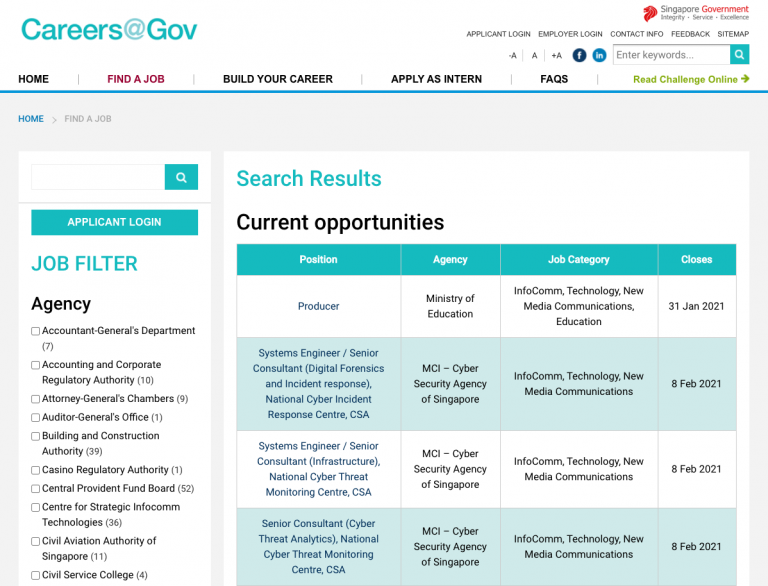
The right job, of course, will depend on your qualification, and the Singapore government’s Careers@Gov website has an extensive list of vacancies to help you get a better idea of what is available to you.

Screenshot of Careers@Gov Job Listings (Jan 2021)

Singapore’s bustling public sector opens many avenues for graduates to enter under the wider umbrella of government employment. This presents several benefits that are perhaps especially tailored to young careers. These benefits can certainly give you an advantage of stability and early access in an ever-developing job market, but they can also have drawbacks that might only be apparent a few years in.

The good news, however, is that these benefits are still ultimately advantageous to new graduates, and the drawbacks can be mitigated with a sufficient amount of foresight, mentorship and market understanding.

With that said, let’s break down the pros and cons of Singapore’s public sector, beginning – of course – with the reasons why it might be a good career choice for you.

Benefits

Higher Entry Salary

Government positions often provide higher entry level salaries to new graduates entering the job market. This is partly down to public funds being made available to fund the next generation of skilled labourers in an effort to stimulate the economy now and safeguard future growth as you learn your trade and continue to contribute to your industry.

A higher entry salary doesn’t just benefit government and the economy, however. It has obvious benefits for you as an emerging graduate. You may find that entering the job market also means needing to change your accommodation to be closer to your place of employment. It may also mean needing to make concessions for transportation, whether budgeting for commutes – which most on-campus students may not have had to consider previously – or renting your own car if work travelling involves more than just moving between your house and job.

A higher entry salary can also have an advantage in helping you earn a higher credit score earlier in your career, which has long term benefits when it comes to seeking home loans should your accommodation needs expand or business loans should you look to open your own practice later on.

Higher entry-level salaries is one of the biggest benefits to the public sector and can help you get an early start on building the life and career you aspire for at the first step.

More consistent work condition regulation

Public sector positions, of course, are also under stricter regulation and oversight than their private sector counterparts. This is due, in part, to governments wanting to reduce wastage of tax funds by ensuring optimal working conditions, and also a public responsibility towards labourers.

More stable regulations have benefits beyond safeguarding working conditions, however. Work environments that are better structured to protect their work force from fatigue, excessive stress and unfair working conditions often lead to more productivity and the kind of longevity that can sometimes be ground down by the fast-paced nature of the private sector.

Better regulation also means stronger employment practices that decrease the chances of unfair dismissal and hiring policies. For native Singapore workers, there is also the added benefit of being prioritised in the public sector as government looks to funnel funds firstly through citizens who are more likely to contribute to the country over the course of their lives.

Potentially meaningful work

Working in the public sector also means aligning your career with public interest, as your job will be created and maintained through public taxes. As a result, the expectation will be that your job should contribute value directly back to the people levying for it.

This kind of work can have benefits beyond finances. If you are a graduate who is particularly passionate about your field, public sector work can provide you with opportunities to contribute meaningfully back to society while also earning a competitive early wage.

The emotional and political fulfilment of public sector work should not be overlooked. While it may be easier for you to focus on the material gains of early public sector life, public service can also put you in positions to learn unique and nuanced perspectives about how your industry impacts wider society, and how you can position yourself to contribute.

Stability

If you are recently graduated, it may be that you have many preconceived ideas about what your industry looks like. This idealised working environment could be something you picked up during job searches, or it could have been manifesting throughout your entire tertiary education career. If this is the case, the reality check of entering a robust working environment can be a shock to overcome for some. This is nothing to be ashamed of – it’s a reality of life and the job market, and many professionals will find themselves continually surprised even well into their middle and later years.

These surprises are also not always rooted in graduates’ heads. Many sectors can change dramatically between the time graduates first choose their degrees of choice and when they actually graduate. This means that the best thing for you, sometimes, is to enter into an industry where you are better protected against unexpected change to allow you to safely adapt to it.

The public sector offers this stability in that policy and practices don’t tend to change much in reaction to shifting markets. Indeed, with much of the money invested into the public sector relying on reliable projections of market activity and minimal shifts.

If you are a new graduate, it would be wise to also assess the stability of your chosen industry, and make your early career choices according to not just where you could earn more money, but where risks are better managed. In many cases, stability is as beneficial as growth.

Better Benefits

Public sector positions tend to have better regulation around additional benefits, with many offering dental, healthcare and security benefits to supplement a higher lower level salary. These benefits coming as part of your contracted work can serve to lower your expenses for additional services you might have otherwise had to pay for out of pocket

The saying often goes that the best businesses don’t just increase profits, they cut down on unnecessary spending, and this is exactly the advantage available to you if your public sector job includes health and security benefits.

Drawbacks

Slow Career Growth

It may be a benefit to the public sector that it’s dedication to stability is centred around keeping people employed. The downside to this, however, is that stability often comes at the cost of upward mobility.

In a bid to minimise the kind of moving parts that lead to both a healthy vertical corporate culture and a dangerous high turnover, public sector employees will often be far more conservative in their promotions and reshuffling at lower level positions.

This doesn’t mean that the door to middle and upper management will be barred from you, it simply means that progression can be slower. This may not be something you consider when first looking for a new job. It might not even be something that becomes overwhelmingly evident in your first few years of employment, but it is something you should understand about the nature of public sector employment.

Lower pay in higher positions

While public sector work might offer a higher initial salary, this does come with the caveat that public sector jobs tend to pay less than their private sector counterparts in middle and upper management positions. As you grow in the public sector, you might find that your salary is adjusted as you climb the ladder, but is also subject to industry-wide salary caps.

This is because the public sector might be able to pay more upfront to create viable job opportunities for fresh graduates, but it also has to balance this by mitigating bloated salaries in higher positions. After all, the public sector is still accountable to taxpayers and has to be responsible with how it distributes tax money into the job sector.

Feature Image 2 - Government vs Private Sector Jobs in Singapore

What types of Private Sector Jobs Can I Find as a Fresh Grad?

Singapore’s private sector is certainly geared towards growth in key industries over the next five years. It also offers fast-paced markets that can lead to rapid career rises and company projections. The inverse is that it’s also a sector with a higher risk element – which is why private sector companies invest so heavily in risk management.

This sector often includes more finance-based vocations like accountancy, business management, and executive coaching. It also has a higher focus on management positions and administration geared towards market influence.

Singapore is especially geared to see growth in the banking and tech industries in the next five years as companies look to take advantage of the medium term need for digital and engineering infrastructure and economic restructuring.

Benefits

Higher Salary Caps

The private sector is where money moves and so do people. It’s a high investment, high turnover collection of industries and the massive volumes of money on hand – combined with less defined salary regulations – means that salaries in middle and upper management cap much higher than in the public sector.

Depending on the company, this can be true too at entry level positions, as privately owned companies compete with each other to attract the best emerging graduates. Ultimately, competition is what defines the private sector, and for this reason, if you as a graduate can ensure that you stand out from your peers, you put yourself in a position to negotiate for a lucrative entry contract.

More expansive portfolios

Competition in the private sector also breeds diversity. The nature of the varying work means you may have the opportunity to build a much more diverse portfolio than you would in the public sector.

A diverse portfolio has two key benefits. The first is that it rapidly increases your experience by putting you in positions to learn different aspects of your industry by working with companies that have unique needs and requirements of its staff.

The second benefit comes down to future-proofing your next job application. Two applicants with the same qualifications and similar years of experience will often be differentiated by their portfolios in the private sector. Ensuring that yours is expansive can give you the edge when it’s time to move from entry positions to the next level, either at your current company or another in the private sector.

Market positioning

The private sector is a growth haven for many start-ups in the modern era. It’s a sector that heavily favours and invests in entrepreneurship and innovation. As a graduate, this sector puts you in a unique position to help companies rise from the ground up and gain the kind of experience that cannot be found as easily in more established businesses.

Positioning yourself early in a start-up that goes on to become a success can also help you fast track your career by growing with a company and seeing your benefits rise with its value. Ultimately, this aspect of the private sector will require some risk assessment from graduates who will have to weigh up the present market with a potentially rewarding future.

Faster vertical progression

With its focus on growth, entrepreneurship and competition, the private sector sees many companies fluctuate in their value and aims almost every year as they strive to be competitive. If you can prove your ability to adapt to rapidly shifting markets, you can put yourself in the eye of executives looking for management that can steer a ship through choppy waters.

There is a potential for rapid promotions in this. However, it requires a graduate who is fast-thinking, innovative and proactive, who knows how to seize an opportunity and present their best selves to executives.

Drawbacks

More competitive job market

Competition, of course, is not always positive, especially for young graduates who, at times, can be seen as commodities to be traded in the private job sector. Many graduates understand the intrinsic benefits of learning to move within the private sector, and as a result, there will be many of you fighting over a finite number of positions if you wish to enter an established company.

Even start-ups will have their picks of hungry young professionals who want to stand out. This competitive job market can be stressful, and one should consider the risk of trying to start out in a much more competitive professional environment.

You will also be competing with young professionals who cut their teeth in the public sector and come into the private market with a level of experience that you might not have yet. For many, it is an end point rather than a start point, and you should consider if this is the market for you to learn in.

Less stable work

This competitive professional environment also applies once you’ve earned a job in a private company. It may not be that your position is constantly under threat, but with many qualified graduates in the wings, replacing you won’t always be as difficult as it might be in the public sector where positions are less coveted.

This lack of stability doesn’t necessarily represent the best environment for a fresh graduate to get their feet under themselves, especially with the added pressures of life after graduating.

Fewer Benefits

Private sectors also grow through fewer regulations and oversight, with companies much more autonomous in their practices and policies. With this in mind, you should always be aware of how and where your industry can shift on a dime with fluctuating trends and the impact this will have on your industry, your employer and your job.

Less Regulation

This lack of regulations also means that job benefits aren’t standardised across companies. While many private companies might offer unique and even better benefits than their public sector counterparts, many won’t offer even the basics.

This, combined with a lower entry-level salary for many positions, might mean you pay the cost much early for potential future gains.

Ultimately, understanding the industry that’s right for you will be a personal decision, but it will be important to have knowledge on both as well as a plan built according to what your end game is. Don’t fret, though. Combining knowledge with good planning can be what separates you from other graduates.

Top 20 Most In-Demand Jobs in Singapore in [year]

Top 20 Most In-Demand Jobs in Singapore

Top 20 Most In-Demand Jobs in Singapore in 2023

It’s the beginning of a new year. And what a year the past year has been. The effect of the COVID-19 pandemic has been profound. It has impacted everything from healthcare, technology, how people interact, and, yes, how they work.

In fact, one of the biggest impacts has been on the job market. From companies closing and employees being laid off, to companies finding innovative ways to make work-from-home environments work for them. With digital transformation and new technologies, companies are now able to use remote work as their only mode of operation.

But it goes further than that. Remote work could also open up opportunities for job seekers worldwide and create global competition for every opportunity. In simple terms, it’s now more important than ever to have the right skills to find the in-demand jobs.

And that’s probably the reason why you’re reading this. You’ve probably wondered which are the most in-demand jobs in Singapore. Because, let’s face it, getting in-demand skills and in-demand jobs is a surefire way to find your footing in the job market and see the pandemic through.

So, what are the most in-demand jobs in Singapore? What skills are in high demand? This post will look at these questions in more detail. So, what are you waiting for, read on to see some in-demand jobs in Singapore?

What skills are in high demand in Singapore?

What do the most in demand jobs in Singapore all have in common? Yes, they’re underpinned by certain in demand skills. A common theme in all these in demand opportunities are skills in technology, healthcare, and marketing. And it makes sense, as these skills are where most focus has been during the pandemic, whether it’s clinical research, development of new technologies, or using innovative marketing strategies to ensure success for companies.

If you want to stand out from the crowd, learning and developing some of these skills will help you most:

  • Data Analysis. Data analysis is the process of cleaning, transforming, and analyzing data to get valuable insights from it. It also includes collecting the data from software platforms and products, cleaning the data, interpreting and visualising it in the form of charts and tables. It’s used everywhere from marketing, to business management, and is an integral part of machine learning which is becoming increasingly important as many businesses are using machine learning and artificial intelligence in their digital transformation efforts. There’s a wealth of resources, both free and paid, available online where you can learn this skill.
 
  • Adobe Photoshop. Photoshop is the go-to tool for anything that has to do with photo and graphic editing. As such, some of the jobs that require the use of photoshop include graphic designer, photographer, web developer, and artists. In recent years, and with the growth of digital marketing, these jobs now also include things like marketing personnel, social media marketers and managers, and even public relations executives. You can learn this skill for free through many free resources online or by enrolling in a course by Singapore Workforce Skills Qualification (WSQ), or through Adobe’s own learning resources.
 
  • Social Media Marketing. One of the pillars of any effective digital marketing campaign, social media marketing is becoming more popular by the day. Think about it, Singapore alone has more than 4.6 billion social media users which gives businesses a perfect platform to market their products and services. Because of this, more businesses and marketing agencies are looking for capable social media marketers. A simple online search will give you many online courses and other resources to learn this skill.
  • SQL. One of the main tools in data analysis, SQL (Structured Query Language) allows businesses to store information about customers and business partners in a relational database and retrieve that information easily at any time. Because of this, it often forms the backbone of many popular business software platforms like marketing platforms, email automaters, and project management tools. Platforms like W3Schools and Codecademy present courses where you can learn this skill.
 
  • Digital Marketing. When you consider that digital marketing encompasses all marketing efforts to create awareness on digital platforms, it’s easy to understand why it’s so popular, especially when an increasing number of consumers are consuming digital content during the pandemic. It’s also a constantly evolving industry where there’s a constant need for skilled and fresh talent. It thus makes sense that many businesses would need an inhouse digital marketing expert. Similar to the other skills, there are a wealth of resources available to learn this skill. One of the best ways to gain exposure is to join a digital marketing agency; you’ll get to work on diverse client accounts and stay on top of the latest industry trends.
 
  • Javascript. As the language of the web, there’s simply no shortage of opportunities available to skilled Javascript developers. You’ll find it in most websites you visit and even some popular desktop software. Because of this, this demand will increase as more businesses are realizing the importance of having a rich and interactive online presence. Like SQL, platforms like W3Schools and Codecademy offer courses where you can learn this skill.
 
  • Market Research. Market research gives businesses relevant data to help solve business challenges, and allows for strategies such as market segmentation and product differentiation. Here, think of a business that wants to market its product to a specific market segment. Although businesses hire dedicated market research analysts, this skill is also valuable in marketing, sales, and management.
 
  • Customer Relationship Management. In a customer-centric world, customer care is crucial if any business wants to survive. In simple terms, happy customers are returning customers and businesses who want to take advantage of this need excellent customer relationship management. Besides, as it’s so important, it forms an integral part of any digital marketing strategy. Platforms like LinkedIn Learning and Udemy have many resources available for you to learn this skill.
 
  • Python. As machine learning and artificial intelligence is becoming more popular, the demand for skilled Python developers is on the up. You’ll find it in everything from chatbots to recommender engines and intelligent apps that consumers and businesses use every day. And you don’t need to limit yourself to machine learning, as it’s also used in web development and cyber security. You can find courses to learn Python on most e-learning platforms and even YouTube.
 
  • js. There is no shortage of opportunities in React.js, one of the most popular Javascript libraries. Because of this, you’ll find that jobs like front-end developers and mobile engineers require it and as the need for more websites and apps increases, so will the demand for React. Like the other programming languages mentioned here, most e-learning platforms offer courses on React and you’ll also find a wealth of free resources, starting with the React homepage.                                                                                                  

Now that you’ve seen some of the in demand skills, it’s about time we look at the most in demand jobs in Singapore in. Keep in mind that some of these jobs will differ in name and description, but will require the same skills, so it’s always important to read the description carefully and do some research.

You’ll also notice that jobs in Singapore in high demand, in one way or the other, rely on or are based on technology. It’s simply where the market is headed and, at this stage, technology jobs are some of the most in-demand jobs in Singapore in.

Considering this, let’s look at jobs in Singapore in high demand and high salaries.

1. AI Specialist

Other titles: AI Developer, AI Engineer, AI Scientist

Salary Range: Average of S$58,000 per year

Companies Hiring: Pencil, Accenture, Continental, DBS Bank, Samsung

Prospects: As AI is becoming increasingly popular, this position has very good prospects.

👉 Browse AI Specialist Jobs on GrabJobs

2. Digital Marketer

Other titles: Digital Marketing Specialist, Digital Marketing Strategist, SEO Specialist, Social Media Marketer

Salary Range: S$3,000 to S$7,000 per month

Companies Hiring: PropertyGuru.com, Randstad, Singtel

Prospects: Because digital marketing is at the forefront of marketing during the pandemic, there will be excellent prospects for some time.

👉 Browse Digital Marketing Jobs on GrabJobs

3. Robotics Engineer

Other titles: Robotics Technician, Automation Engineer

Salary Range: S$17,000 to S$84,000 per year

Companies Hiring: GE, Polybee, PATEC Group

Prospects: With many industries moving toward automation, there is some room for opportunity and growth, but keep in mind that these positions are often for highly skilled and experienced job seekers.

👉 Browse Robotics Engineer Jobs on GrabJobs

4. Full Stack Engineer

Other titles: Full Stack Developer, Full Stack Software Developer, Full Stack Web Developer

Salary Range: S$3,000 to S$8,000 per month

Companies Hiring: Nexlabs, Singtel, Transferwise

Prospects: Very good, from entry level through very experienced.

👉 Browse Full Stack Software Engineer Jobs on GrabJobs

5. Backend Developer

Other titles: Backend Engineer, Backend Programmer

Salary Range: S$2,000 to S$8,000 per month

Companies Hiring: Qavar, Reebelo, Shell Infotech

Prospects: Very good, from entry level through very experienced.

👉 Browse Backend Developer Jobs on GrabJobs

6. Data Scientist

Other titles: Data Analyst

Salary Range: S$20,000 to S$102,000 per year

Companies Hiring: HP, KPMG

Prospects: Excellent, taking into account how many businesses are moving towards data analytics in business processes.

👉 Browse Data Scientist Jobs on GrabJobs

7. DevOps Engineer

Other titles: Platform Engineer, Reliability Engineer

Salary Range: S$4,000 to S$8,000 per month

Companies Hiring: Quantlab, Volt, Binance

Prospects: DevOps engineers face steady career growth as the demand for automation and lifecycle management increases.

👉 Browse DevOps Engineer Jobs on GrabJobs

8. Data Engineer

Other titles: Big Data Analyst, Technical Architect, Solutions Architect

Salary Range: S$46,000 to S$133,000 per year

Companies Hiring: Indeed, Rakuten, HP

Prospects: Being a growing profession, there are many opportunities available for data engineers, with the demand only expecting to increase.

👉 Browse Data Engineer Jobs on GrabJobs

9. Cyber Security Specialist

Other titles: Cyber Security Analyst, Security Engineer

Salary Range: S$4,000 to S$5,000 per month

Companies Hiring: Govtech, Volt, Singtel

Prospects: With more online services comes more security risks and more demand for cyber security specialists.

👉 Browse Cyber Security Jobs on GrabJobs

10. Community Specialist

Other titles: Community Manager, Communications Specialist, Communications Coordinator

Salary Range: S$2,000 to S$9,000 per month

Companies Hiring: Cisco Systems, Allianz Global

Prospects: The increase in social media usage increases the demand for community specialists.

👉 Browse Community Specialist Jobs on GrabJobs

11. Partnership Specialist

Other titles: Partnership Manager

Salary Range: S$3,000 to S$5,000 per month

Companies Hiring: TikTok, Bytedance, Singtel

Prospects: Very good as many businesses are relying on strategic partnerships to ensure continued success.

👉 Browse Partnership Specialist Jobs on GrabJobs

12. Clinical Specialist

Other titles: Clinical Applications Specialist, Clinical Manager

Salary Range: S$80,000 to S$90,000 per year

Companies Hiring: Thermo Fisher, Changi General Hospital

Prospects: Because the pandemic has put health at the forefront, excellent prospects will exist for some time to come.

👉 Browse Clinical Specialist Jobs on GrabJobs

13. E-Commerce Specialist

Other titles: E-commerce Associate, E-commerce Manager

Salary Range: S$34,000 to S$133,000 per year

Companies Hiring: Hasbro, Tate Asia, Salesforce

Prospects: E-commerce is only expected to increase in the coming years, and with it, the demand for e-commerce specialists.

👉 Browse E-Commerce Specialist Jobs on GrabJobs

14. Customer Success Specialist

Other titles: Customer Success Manager, Customer Service Agent

Salary Range: S$55,000 to S$78,000 per year

Companies Hiring: VMWare, Cisco Systems, Salesforce

Prospects: Many opportunities exist for customer success specialists, and it also offers a springboard for many other positions within a business.

👉 Browse Customer Success Specialist Jobs on GrabJobs

15. Product Owner

Other titles: Product Manager, Product Director

Salary Range: S$61,000 to S$200,000 per year

Companies Hiring: TikTok, Bank of Singapore,  Singtel

Prospects: The product owner role is becoming increasingly popular as businesses are focusing on providing customers with the products they want. Thus, more products means more demand for product owners.

👉 Browse Product Owner Jobs on GrabJobs

16. Creative Copywriter

Other titles: Copywriter

Salary Range: S$34,000 to S$63,000 per year

Companies Hiring: Elixir Technology, Ogilvy

Prospects: With the need for increased marketing across all channels comes an increase in demand for copywriters.

👉 Browse Creative Copywriter Jobs on GrabJobs

17. Human Resources Professional

Other titles: People Operations Specialist, Human Resources Partner

Salary Range: S$17,000 to S$142,000 per year

Companies Hiring: TikTok, Embraer, Hubble

Prospects: Very good considering that companies are increasingly focusing on employee satisfaction in their operations.

👉 Browse Human Resources Jobs on GrabJobs

18. Sales Executive

Other titles: Salesperson, Business Development Executive, Business Development Manager

Salary Range: S$10,000 to S$90,000 per year

Companies Hiring: Child Education Co, Stonrich

Prospects: As long as there are products and services to sell, there will be a demand for people to sell them, so the prospects are good.

👉 Browse Sales Executive Jobs on GrabJobs

19. Helpdesk Agent

Other titles: Customer support, Service Desk Analyst

Salary Range: S$2,000 to S$3,000 per month

Companies Hiring: Singtel, Collabera

Prospects: The helpdesk is an integral part of any effective customer service strategy and there’s always demand for skilled help desk professionals.

👉 Browse Helpdesk Agent Jobs on GrabJobs

20. UX / UI Professional

Other titles: User Experience Designer

Salary Range: S$3,000 to S$66,000 per year

Companies Hiring: HP, Razer, Credit Suisse

Prospects: Customers are placing an emphasis on the user experience when choosing a business to buy from. As this needs increases and customer needs evolve, the demand for UX / UI Professionals will increase.

👉 Browse UX / UI Jobs on GrabJobs

Closing thoughts on the Most In-Demand Jobs in Singapore

There you have it, a straightforward guide to the in-demand skills and the most in-demand jobs in Singapore in. Now it’s up to you to take the next step and ensure success in your future. So, read a little, research a little, and maybe do a course or two.

Now we want to hear from you. What job on the list do you find most appealing? What interests you most? Let us know, we’d love to hear from you.

Best F&B Job Sites in Singapore

F&B

Have you been searching for a job that is set in the background of the Food and Beverage sector? If you answered yes, this article is most likely going to be a great form of career resource for your job hunt. In this piece, you’ll find a list of the 5 best F&B job sites in Singapore!

Do any one of the positions of ‘service crew’, ‘barista’, ‘cook’, ‘bartender’ or ‘restaurant manager’ sound interesting to you? Are you feeling excited to take on a career in the F&B industry? If so, you can embark on looking at some of the F&B positions available at numerous outlets in the F&B industry of Singapore! 

Locking in a F&B position will enable you to do all the things you love so much about working in the food and beverages industry in Singapore! 

In this article, you will find a compiled list of the 5 best F&B job sites in Singapore. Each paragraph with a little bit of information about the portal, so as to better cater to your job hunt needs. 

We hope the information helps you along on your job search experience!

GrabJobs is a cost-effective recruitment solution that automates sourcing, screening and interviewing of candidates. It does so with over 5,000 companies using the job platform to simplify their hiring process.

Tired of filling in your personal and professional details on multiple job sites? 

On Grabjobs, Job Seekers will have their profiles automatically generated for them. They can begin applying for new jobs in under a minute with the automated chat-bot pre-screening interviews. 

Following which, shortlisted candidates will then have an interview with the employer scheduled for them. Applicants will also receive automated reminders to attend these interview sessions! Automation at its best.

It is also one amongst the top 5 F&B job sites in Singapore, and has been acknowledged so recently on MediaOne. With companies like Poke Theory, Frenchie’s Wine Bar, Les Bouchons, Monster Curry, Copper Chimney, Beer Basket Kitchen & Bar, and so many others offering similar opportunities, GrabJobs is a great resource for those looking to secure a position within the F&B industry.

GrabJobs also curates content that is industry-specific. Visit our blog page if you’re interested in finding out which are the top 5 service crew and top 5 kitchen jobs in Singapore!

Last but not least, don’t forget to visit GrabJobs at this link to find a position that matches your needs within the FnB industry.

The next job portal that also offers numerous positions within the F&B sector is GumTree. 

GumTree is one of the best job sites in many countries. With over tens of thousands of job opportunities, individuals can search for jobs in the health, sales, retail and construction sectors among others. 

The site also allows job seekers to filter their searches based on category, location or the advertiser. The last filter being a cool function that allows you to pick specific companies of you choice! 😉

Gumtree_fnb

Gumtree was established in March 2000 as a local London classified ads and community site. It has since expanded as an ever growing community all around the world. 

Their mission is to provide a simple and easy-to-use tool that lets individuals quickly find what they may be looking for. This can include anything from an object at a bargain price to a dream job, flat or event a pet to adopt!

Gumtree also offers positions of service crew staff, waiters, cook, chefs and others with a myriad of F&B agencies. Some of these companies include Bistro Bar as well as Black & Ink amongst others.

To find out more about the Food and Beverage related work positions that Gumtree offers, visit them here!

JobsCentral is yet another F&B job site that offers positions related to the Food and Beverage industry in Singapore. It is also one of the top providers of jobs, education, scholarships and career information and applications in Singapore. 

They are well-recognised by employers, schools and jobseekers alike for their innovative and fresh approach to career services. They also have a reach of over 2 million individuals yearly. 

JobsCentral is one of Singapore’s largest career portals as they have over 800,000 users on the platform. Some of you may have heard of their sister portal – BrightSparks, a top scholarship and education media for pre-tertiary students. 

JobsCentral joined CareerBuilder, the largest job portal in the US. This allows them to leverage upon CareerBuilder’s global resources and cutting edge technology. Further, enabling them to reaffirm their position within the recruitment market.

Their user-friendly interface also makes them one of the best F&B job sites in Singapore!

JobsCentral: Best job sites in Singapore

With FnB outlets such as Creative Eateries and The Privé Group on their belt, JobsCentral offers positions of Head Chef, Baker and Bartender amongst others.

To find out more about the F&B sector related work positions that JobsCentral offers, visit them here!

Freeboh is a leading integrated shift-based full-time/part-time jobs marketplace where work fits real life with just a few clicks. 

They provide an exclusive platform for shift-based employment opportunities. Jobseekers can simply set up an introductory profile and apply for the shifts that suit their schedules!

Freeboh also allows individuals to check their own work schedules or trace back their work and pay records! They aim to help jobseekers achieve customised working schedules to fit their life and needs, not the other way around. 

They believe that shift-based hiring endorses flexibility and scalability for both businesses and employees. All in all, everybody wins!

Freeboh

Freeboh is also one of the top 5 FnB job sites in Singapore that offers a variety of opportunities within the food and beverage industry. 

Some of the companies looking to hire include 805 Seafood Kitchen, Wholesome Savour, Gloria Jean’s Coffees and others. 

Visit the job site here to source for F&B specific job positions!

Last but not least, Indeed.com is one of the top 5 F&B job sites to offer splendid opportunities within the working sector of food and beverage in Singapore.

Indeed: Best job sites in Australia

It is also the #1 Job Portal site in the world with more than 250 million visitors every month. Indeed puts job seekers first by giving them free access to search through jobs, post their resumes and research companies.

Their mission is to help people get jobs by helping individuals along on their job hunt process. Indeed has more than 10,000 global employees passionately pursuing this purpose. They do so by improving the recruitment journey through real stories and data. 

Are you ready for a little tip/trick that not many others may know about in relation to the job portal? If you go to Indeed’s home page and scroll to the bottom of their website, you’ll find a tab called “Salaries” in the footer. 

Clicking on this extension will take you to a page that’s less explored by job seekers worldwide. Browse jobs, companies and industries based on the salary information provided by individuals!

A quick search on Indeed with the filter of high-salary-paying companies within the F&B industry revealed that the Coca Cola Company, Dunkin Donuts, and Mondelez International were employees’ popular favourites. 

Visit Indeed here if you’re interested in FnB job positions at hirers including Hillton Hotels & Resorts, Orchid Hotel, Marina Bay Sands and Ginza Shinto amongst others!

With that, you have a compiled list of the 5 best F&B job sites in Singapore! We hope this article serves you useful as you embark on your job search. We wish you all the best ahead!

If you’re on the lookout for jobs within other industries that are nonetheless located in Singapore, here’s an article that shares with you the best job portals in Singapore.

No matter the industry or the position, remember to visit GrabJobs to find a job opportunity with ease in Singapore!

Best Retail Job Sites in Singapore

Retail

Do jobs in the retail sector call out to you? If so, are you currently searching for a job opportunity in the retail sector? Great news! This article has a compiled list of the top 5 retail job sites in Singapore to help you on your job search. 

Perhaps, you’re one to derive joy from jobs that cater to your customers’ satisfaction! Or maybe you enjoy interacting with numerous individuals who are looking to make a purchase at the store! With this list, you can embark on looking at some of the interesting retail positions available at numerous outlets in Singapore! 

Locking in such a retail position will enable you to do all the things you love so much about working in the retail industry in Singapore! 

In this article, you will find a compiled list of the 5 best retail job sites in Singapore. Each paragraph with a little bit of information about the portal, so as to better cater to your job hunt needs. 

We hope the information helps you along on your job search experience!

GrabJobs is a cost-effective recruitment solution that automates sourcing, screening and interviewing of candidates. It does so with over 5,000 companies using the job platform to simplify their hiring process. 

Tired of filling in your personal and professional details on multiple job sites? 

On Grabjobs, Job Seekers will have their profiles automatically generated for them. They can begin applying for new jobs in under a minute with the automated chat-bot pre-screening interviews. 

Following which, shortlisted candidates will then have an interview with the employer scheduled for them. Applicants will also receive automated reminders to attend these interview sessions! Automation at its best 😉

It is also one amongst the top 5 retail job sites in Singapore, and has been acknowledged so recently on MediaOne. With companies like Kate Spade, Club21, 7-Eleven, QianJing Crystal and so many others offering similar opportunities, GrabJobs is a great resource for those looking to secure a position within the retail industry.

GrabJobs also curates content that is industry-specific. Visit our blog page if you’re interested in finding out which are the top 5 retail jobs in Singapore for the month of October

If you’re worried about the questions you might get asked during an interview for a job position set in the retail industry, give this article by GrabJobs a read!

Last but not least, don’t forget to visit GrabJobs at this link to find a position within the retail industry!

Built on the foundation of increasing workplace transparency, Glassdoor offers millions of the latest job listings. They do so alongside their growing database of company reviews too. 

Additionally, job seekers can also view CEO approval ratings, salary reports and interview reviews and questions. 

Glassdoor is also one of the top 5 job portals in Singapore that offers numerous positions within the retail sector! 

Glassdoor: Best job sites in Australia
Their portfolio of retail employers include L’Oreal, Cornerstone, Marie’s Lapis Cafe, Adecco Personnel amongst many others. Each job posting will be accompanied with other useful information that job seekers can look into. Some of these information include salary details as well as reviews by previous or past employees. One can also find out what sort of benefits to expect from joining the firm in the future. Anything from bonus payments to work-life balance and commissions can be discovered!

To find out more about their specific sector related work positions that Glassdoor offers, visit them here. 

Next up, Indeed.com is one of the top 5 retail job sites to offer splendid opportunities within the working sector of retail in Singapore.

Indeed: Best job sites in Australia

It is also the #1 Job Portal site in the world with more than 250 million visitors every month. Indeed puts job seekers first by giving them free access to search through jobs, post their resumes and research companies.

Their mission is to help people get jobs by helping individuals along on their job hunt process. Indeed has more than 10,000 global employees passionately pursuing this purpose. They do so by improving the recruitment journey through real stories and data.

Are you ready for a little tip/trick that not many others may know about in relation to the job portal? If you go to Indeed’s home page and scroll to the bottom of their website, you’ll find a tab called “Salaries” in the footer.

Clicking on this extension will take you to a page that’s less explored by job seekers worldwide. Browse jobs, companies and industries based on the salary information provided by individuals!

A quick search on Indeed with the filter of high-salary-paying companies within the Retail industry revealed that the Cotton On Group, IKEA and 7-Eleven were employees’ popular favourites.

Visit them here if you’re interested in retail job positions with hirers including Uniqlo,  Changi Airport, Lovisa, and Cotton on, amongst others!

One of Asia’s leading online employment marketplace. JobStreet facilitates the matching and communication of job opportunities between job seekers and employers in Singapore, Malaysia, Philippines, Indonesia and Vietnam. 

Founded in 1997 in Malaysia, JobStreet now has a team of over 800 talented individuals. This gives them the advantage of a strong local presence in every country in which they operate. 

With their understanding and insights of each market, as well as their passion for technology, they provide jobseekers with the best opportunities. In November 2014, JobStreet became part of the Australian Stock Exchange-listed SEEK Limited. SEEK is the world’s largest online employment marketplace by market capitalisation. 

JobStreet’s vision is to connect businesses with talent and improve lives through better careers. A mission they are striving to deliver with excellence!

JobStreet: Best job sites GrabJobs: Best Job Site for part-time jobs
It is also one of the best retail job sites in Singapore that offers a variety of opportunities within the same industry. Some of the companies looking to hire include Smiggle, Lim’s Holland Village, Rue Madame, Marquis Furniture and many others. Visit the job site here to source for retail specific job positions now!

JobsCentral is yet another job site that offers positions related to the retail industry in Singapore. It is also one of the top providers of jobs, education, scholarships and career information and applications in Singapore. 

They are well-recognised by employers, schools and jobseekers alike for their innovative and fresh approach to career services. They also have a reach of over 2 million individuals yearly. 

JobsCentral is one of Singapore’s largest career portals as they have over 800,000 users on the platform. Some of you may have heard of their sister portals – BrightSparks, a top scholarship and education media for pre-tertiary students. 

JobsCentral joined CareerBuilder, the largest job portal in the US. This allows them to leverage upon CareerBuilder’s global resources and cutting edge technology. Further, enabling them to reaffirm their position within the recruitment market.

Their user-friendly interface also makes them one of the best retail job sites in Singapore!

JobsCentral: Best job sites in Singapore

JobsCentral also offers positions of sales executive, retail ambassador/assistant and others with a myriad of well-known agencies. Some of these companies include Pet Lovers Centre, Kopitiam Investment, The American Club, amongst others.

To find out more about the retail sector related work positions that JobsCentral offers, visit them here!

With that, you have a compiled list of the 5 best retail job sites in Singapore! We hope this article serves you useful as you embark on your job search. We wish you all the best ahead!

If you’re on the lookout for jobs within other industries that are nonetheless located in Singapore, here’s an article that shares with you the top 19 job portals in Singapore.

No matter the industry or the position, remember to visit GrabJobs to find a job opportunity with ease in Singapore!

Top 10 Summer Holiday Jobs in Singapore

top-jobs-industries-part-time-full-time

When the summer holidays come around, students find time to pursue part-time roles or internships for relevant industry experience. How can we help you, then? By giving you a list of the top 10 summer holiday jobs that students like to take on in Singapore!

Having a part-time job on your resume helps prospective future employers to gauge your level of work experience. It also provides you with some extra income! 

As always, check the rule and regulations detailed on the MOM webpage to be sure that you are abiding by the law when working in Singapore. If ever in doubt, contact them either through an email or phone enquiry to ask your questions. If all’s looking good, let’s jump right in!

Here are some popular summer holiday work opportunities to explore during your holidays:

Retail is one of the most popular industries that’s constantly hiring. With the low barriers to entry and high demand, many students are keen on these roles. We’ve also discussed previously in another article the challenges and opportunities this industry carries. 

Roles of retail assistants, retail ambassadors and the like are always in demand. Even when many of us have chosen to go with online shopping, some individuals prefer visiting the brick and mortar stores. 

Such outlets can often use some extra hands on deck to help manage the crowds. What are you waiting for?

👉   Browse Retail Jobs on GrabJobs

Some of the popular summer holiday jobs that students like to take on during their vacation also include F&B roles: Baristas, Waiters, Waitresses, etc. 

These roles are similar to most retail roles in terms of their emphasis on customer service. In every job position, be it marketing, sales or tech, employees are encouraged to adopt a customer-centric mentality. 

Putting ourselves in the shoes of a consumer to understand their wants and needs is critical for a business. These industries will definitely equip you with the basics of adopting a customer-centric mentality which will be helpful in your future roles.

👉   Browse Food & Beverage Jobs on GrabJobs

If you have a passion for teaching, consider taking up a job in the education industry as a private tutor! This is one of the most lucrative part-time jobs around, especially in Singapore. 

It’s where parents are willing to spend a lot of money on their children’s education. Choose any topic you’re best at, from Languages to Mathematics, as well as the education level, and you’re good to go!

If you’re planning to start out, do consider charging below market rate until you’ve gotten enough tutoring experience or testimonials to charge the market rate and above.

👉   Browse Tutor Jobs on GrabJobs

Were you a Physical Fitness Instructor (PTI) during your army days? Or are you a certified yoga instructor? Don’t waste these skills; teach others how to work out efficiently and effectively by taking on a Fitness Trainer role. 

Do note that these roles require a niche set of skills and relevant certification for you to enter the industry, though. Unless you’re privately training your friends/family members and start by charging them for it! 😉

With so many of us tied to office desks for the bulk of our days, plenty of us are also looking for ways to get moving. Someone who can teach the rest of us how to do it right will indeed be much appreciated!

👉   Browse Fitness Trainer Jobs on GrabJobs

No summer holiday jobs list will ever be complete without including this role in it. 

Enjoy talking to people on the phone? Well, this may just be the job for you! Telemarketing extends to more than just sales & customer service. Some positions require candidates to search for potential leads and contact them accordingly. 

Oftentimes, you are the first contact point for companies. As such, depending on your conversation, it may affect your company’s reputation positively or negatively. That’s quite an important role you’ll be playing then. 

Responsibility, politeness and time management skills are necessary to excel in this job position. And that’s a lot of transferrable skills to be picked up!

👉   Browse Telemarketer Jobs on GrabJobs

This is an oldie but a goodie. The job of sales promoters are always in demand. With IT shows, conventions and the likes being popular in Singapore, many employers need the assistance of sales promoters. 

The key advantages of taking on this type of work includes the short-term, high-pay nature of these work roles. This feature tends to attract numerous students who just need a little boost in income or pocket money. 

Individuals may need to work for long hours, but usually only for a few days. However, they can also reel in much higher rates for their short stint as a sales promoter too! 

Some positions at specific events even allow sales promoters to gain commissions should they manage to lock in certain deals. This means extra income too!

👉   Browse Sales Promoter Jobs on GrabJobs

Besides delivery drivers, many students do part-time work as Grab or GoJek drivers during the school term as well. 

This particular summer holiday job will require you to be at least 18 years old. That’s the minimum legal age required in order for you to acquire a driving license in Singapore. 

If you do have a driving license, especially a Class 3 or Class 4 license, you could make some extra money during the holidays too! Simply, by working as a delivery driver for a number of delivery apps and services.

This is one particular industry that has seen a huge increase in manpower over the recent years in Singapore. With the rise of popular food delivery apps like Grab and Foodpanda, students have started to take on the summer holiday job as a delivery rider with these firms. 

👉   Browse Driver Jobs on GrabJobs

Customer Service roles have an ongoing supply of positions all year round. With its lower entry requirements, it attracts a lot of students as well as fresh grads. 

There are different types of Customer Service roles from back office calls to front desk personnel. Depending on the industry, the responsibilities demanded differs as well. 

However, regardless of the industry, Customer Service personnel are always in need.

👉   Browse Customer Service Jobs on GrabJobs

Admin Assistants handle a myriad of tasks from meeting bookings, minute taking, inventory & pantry stocks, data-entry and other routine tasks. 

Admin positions extend from departmental backgrounds, all the way to personal assistants for management level employees. The summer holiday jobs as administrative assistants can prove useful for you in the future too!

If you’re able to multi-task and you’re organised, this may be the perfect role for you to demonstrate your transferrable skills within a position. Including this in your resume when you set out to job hunt can be helpful too. 

👉   Browse Admin Jobs on GrabJobs

You’ll be surprised at the number of brands that don’t have a website in 2019! 

Design enthusiasts who are proficient enough to have created their own blog can thus take advantage of this fact and help new start-ups or SMEs to craft a straightforward website using a template. 

This tends to be project-based, but it also provides you with a portfolio of work for future employers! A job opportunity that allows you to showcase your artistic/design skills while also building up your portfolio? Yes please!

Proficiency through the demonstration of your work with specific tools, such as Adobe Photoshop and Illustrator, can also be eye-catching factors for your potential employers in the future!

👉   Browse Web Designer Jobs on GrabJobs

Now that you have some ideas as to which summer holiday jobs you can take on, we hope you’ll be able to lock in a great position soon!

If you’d like to explore the above-mentioned and other similar job opportunities, visit GrabJobs here to take a look at some of the available roles now!

The Ultimate Guide to Jobs with No Experience in Singapore

jobs with no experience

Which came first, the chicken or the egg? That question is just about as easy to solve as the riddle that many graduates or mid-careers switchers face when looking for their first jobs in a new field: can you get a job with no experience?

The great news is that yes, there are plenty of positions available that don’t require degrees or tons of experience. If you’re looking to play an integral role in an organization and you’re willing to work hard, there are several no experience jobs that you can enter right away. These jobs will all require no experience.

Some will require little more than a decent work ethic and willingness to learn what you need on the job. Other positions that require little experience can be stepping stones to more senior posts, especially in dynamic, high-demand fields like technology. While conventional education works for some, others choose to break into the field and climb the ranks with new skills developed along the way.

We’ll take a look at some options that rank as the easiest jobs in Singapore. Ultimately, these positions are what you make of them. Over time, if you show exemplary leadership and exhibit skills worthy of promotion, they can be unconventional paths that lead right to the top.

Is it possible to get a job without experience?

Singapore is home to a highly-skilled and competitive workforce. Many of the job portals in Singapore will list openings along with a list of necessary qualifications, like skills and credentials. For students or recent graduates and those who have decided to start over doing something completely different in the middle of their career, pursuing those positions might not be realistic.

Education takes time and money. Without it, you just have to be a little more creative. A customer service representative, for example, only needs the capacity to learn how to use the equipment and follow instructions. It also helps to be friendly and have high emotional intelligence. Still, neither of those are things that you can learn in school anyway. There are also openings in lots of other fields, especially in junior positions. You might take an initial pay cut to earn your employer’s trust and the chance to show off your skills. But with hard work and determination, you can distinguish yourself and start climbing in your career.

Can I get a job in Singapore without a degree?

There are several no experience jobs in Singapore that don’t require degrees. Here are some of the highest-paying jobs that you won’t need to wait to start until after university. Several of these surprising choices would serve even the most adventurous, high-achieving individuals well:

  • Financial Advisor: You’ll need some higher learning, like an IB or polytechnic diploma, to be sure. And then, you’ll need to pass modules 5 to 9A taken from the CMFAS Exam to qualify as a financial adviser. Since the barriers to entry can be overcome if you’re inclined to pursue this profession, it’s your people skills that will set you apart.
  • Cabin Crew: Know that if you love airplanes, there are plenty of opportunities to work with them without having a degree. Becoming an airplane pilot does take considerable time and additional training, but you can join the cabin crew with just a diploma!
  • Executive Chef: You might have to start at the bottom, but it just takes talent and hard work to eventually manage your own kitchen in this competitive arena.
  • Commercial Diver: If you’re a fan of the water, you can quickly and easily learn to dive. Maybe you wind up working for a company leading tourist expedition.
  • Automotive Mechanic: As there are plenty of cars on Singaporean roads, there’s a need for mechanics to maintain them. Work your way up from a rookie to a manager in less time than you might think if you like to tinker with cars.
  • Real Estate Agent/Property Manager: If you can handle the social component of real estate, it might be worth it to take the CEA certification exam. You don’t need a degree, and the commissions and flexible hours can be attractive.

Real Estate

Several occupations, like real estate, can be done without a degree. To work as a realtor in most places, you’ll simply have to familiarize yourself with the rules and become pass the CEA certification exam to sell properties for other people. It may take a bit of effort to get started, but you don’t actually have to go to school to become a realtor.

Tech Careers

As previously mentioned, you don’t need a fancy degree in computer science or software engineering to break into the tech industry, either. Networking with people who are in the field you want to enter can help you get your foot in the door. Taking a really low-ranking position within a company that you’d like to work your way up in is also an excellent strategy to establish yourself in a new field.

Tech positions are especially great for self-motivated people who are willing to start as beginners and forge their own path. Nearly 2/3 of all computer programmers are self-taught. Many simply begin by taking online courses that teach basic coding skills. Then, you can work on developing your signature coding style. From there, take on projects that can eventually be used as part of a portfolio to showcase your skills.

To make the most of this path, concentrate your efforts on a particular set of skills that you enjoy to work on a specialty. Take on a few freelance projects and work up to more difficult ones. You can link some of your best work to online profiles, like LinkedIn, to showcase your talents and expertise. Programmers who capitalize on their niche can eventually earn pretty significant paychecks.

The sky’s the limit!

Focus on the skills and qualifications that you have rather than the ones that you don’t. Believe it or not, you technically don’t even need a degree to be hired for the top job in Singapore—Prime Minister. Though the person who runs the country is usually well educated, a degree is not legally required of the Prime Minister. 

Don’t let the absence of a degree hinder your progress. There are several no experience jobs to be found in many places if you are willing to look for them.

What are the easiest jobs in Singapore to get with no experience?

Jobs that rely heavily on physical labor or innate talent are the ones that you can get without experience. Positions like medical assistants, who assist doctors and nurses with small tasks that keep things going smoothly, can learn a lot on the job after being hired.

Administrative assistants, who are also in high demand right now, don’t need a lot of initial experience, either. To thrive as an administrative assistant, you need to be organized and capable of accomplishing what needs to be done to keep an office humming. If you prove that you can do that, you’ll be rewarded with additional responsibility more often than not. Basically, there are plenty of jobs with no experience in Singapore if you choose to look for them.

What job can I get with no skills?

When you’re looking for a new job, you should pay attention to the difference between a lack of skills and a lack of experience. You can be a mid-career switcher who has decided to take a different path, such as choosing to start over in a completely different field.

In this case, you retain all of the skills you’ve learned and practiced from your previous positions. You can list all of those competencies as you apply for another job. Hopefully, some of those skills, like interpersonal communication, problem-solving, or crisis management, will serve you well in a new position.

However, if you’re just starting out, you may not have many skills to advertise to potential employers. Instead, you’ll need to rely on your work ethic and creativity to distinguish yourself. Most of these jobs with no skills pay you for your physical labor.

Here are some examples of currently listed jobs with no skills in Singapore:

  • Mall temperature screeners
  • Healthcare assistant
  • Bank sales officer
  • Warehouse assistant/loading
  • Security Guard
  • Housekeeper
  • Babysitter
  • Delivery job

Upskilling

To quickly get ahead in any of these positions, you’ll need to focus on upskilling. In your free time, look at ways to develop new skills that will make you better at what you’re currently doing or what you want to do.

Tech is a great field to consider if you don’t have a degree or any other formal training. You could start at an entry-level position in the company that you want to work for, especially if you find a role that offers the potential for advancement and additional training. Even if you’re doing menial tasks at first, you can spend nights or weekends watching online tutorials to learn or improve your skills.

By consistently preparing for the next step of your career, you’ll be ready to move and present skills that you’ve acquired when the opportunity presents itself. Keep in mind that this applies to all jobs, though, as the Singaporean workforce is highly skilled and very competitive.

Thanks to the rapid evolution of technology, everyone in the workforce is always learning and improving to stay ahead. Consequently, upskilling is imperative if you want to remain at the top of your game. Taking the initiative by learning as much as you can to set yourself apart for future roles and leadership positions is a smart move.

What unskilled jobs pay the best?

Job Title

Hourly Pay

Executive secretaries, executive administrative assistants

$16-$23

Legal assistants

$17-$25

Real Estate Agents

$16-$30

Medical Assistants

$16-$22

Customer Care Specialists

$17-$25

Delivery drivers

$10-$26

Sales Representatives

$13-$23

Each of these jobs with no skills in Singapore is an excellent opportunity for individuals entering positions or changing careers without skills or degrees. By working hard to learn the tools of your trade, for some of these, making sure that you know the rules that you’ll need to honor as you work, you can earn a decent living. It will take some time to reach the higher end of these pay scales, but it is possible to make a salary that compares with that of a skilled, educated position.

How can I get a high paying job with no experience?

It will take some time, effort, and creativity to break into specific areas in a non-traditional way, but it can be done! Better still, as you climb the ranks with increasing responsibility, you’ll reach higher salaries, often in line with your educated colleagues as time goes on and you prove your capability. Here are some of our best tips for landing a high paying job without skills, experience, or a university degree.

  1. Take a beginner’s approach. As an entry-level employee at a job with no skills or a job with no experience in Singapore, understand that your time at the bottom of the ladder is critical to working your way up. It is here that you can hone your understanding of your role and the corporate culture of your company. Even if a position is technically beneath you, or you have to take a pay cut, working in this job with no experience will get you ahead in the long-run. It may be worth it to happily accept.

    Stay curious, make mistakes, and do what it takes to learn about what you want out of this position and where you want it to take you as you start developing your career plan. Use this opportunity to network in your field and take any chance that you can to get in the door, no matter what it takes. If you’re lucky, you might even come across a mentor who takes a shine to you.

  2. Always keep learning! Upskilling will help you maintain a competitive advantage in a workforce that is as advanced as Singapore’s. Take advantage of employee training or enhance your skills on your own time to prepare for the job that you want. There are plenty of online courses and tutorials to help you join the ranks of self-taught professionals. Some have even managed to successfully create freelance careers or find themselves in a corporate role that suits them.

    Know that you can gain relevant career experience even without a job. If you like to write, start a blog or a portfolio of writing samples. If you can, develop talent as a hobby. If you’ve taught yourself to code, link some of your best work as you compile a portfolio that demonstrates your strengths and capabilities.

  3. Take the initiative! When you are presented with an opportunity to solve a problem or use a skill you’ve mastered, do it! Ultimately, you want to make yourself invaluable. Devote yourself to continued personal growth and development as you invest in yourself and your talents.

    Be passionate about your side projects and devote time to pursuing the talents that will get you into the career that you want. If you’re going to become a web developer, for example, pick up a few tasks on freelance sites like Fiverr or Upwork. Choose more advanced projects that align with what you’re good at to increase your confidence and build your skills.

Conclusion

Finding a job traditionally involves working hard to secure a degree and gather years of professional experience working your way to upper management. Unfortunately, that path isn’t feasible for everyone. There may not even be a traditional path in place to get you where you want to wind up. Thankfully, there are several jobs with no experience in Singapore that can provide a gateway to profitable and fulfilling careers despite continued education or experience requirements.

Will it take a little creativity and hard work to make the most of these jobs with no skills? Absolutely, but it is possible to do whatever you set out to accomplish as long as you have a plan and work hard to develop yourself in preparation for your future roles. In the absence of formal education, work on upskilling through corporate training or by absorbing information on your own time. Don’t let the lack of a degree hold you back. After all, not even the prime minister must have one, and he is responsible for the entire country.

Just as you may want to consider non-traditional paths to the roles that you desire, you should also consider no experience jobs that may be a bit outside of the box. There are trades that you can learn on the job. As long as you are intentional about learning new skills and actively seeking to apply them, unique and varied experiences can be an asset to your career.

The bottom line is that hard work, determination, and a little bit of ingenuity are required to bypass the typical requirements of skill, experience, and education. You can succeed in many areas simply based on your own merit and personal achievements, regardless of the hardships that lacking these tools usually present. You just have to be willing to work hard for it.